


Designing advice that works for everyone
This is a report about participation in financial advice: who takes part, who holds back and why. Before this becomes about your clients, it first begins with you.
Before you read this report

Think of a time you
weren’t sure of your
place in the room
Think of a time you weren’t sure of your place in the room
Did you
- Wonder if you knew enough to belong in the conversation?
- Hold back a question because you felt you should know already?
- Feel you had to prove your credibility before people would listen?
- Leave thinking, ‘I wish I’d said that’?
- Steer a conversation away from something you weren’t sure how to voice?
Now think of a time you
were the confident
one in the room
Now think of a time you were the confident one in the room
Did you
- Leave a meeting and realise you hadn’t heard everyone’s perspective?
- Notice someone having to prove themselves more than others?
- Wonder what wasn’t said?
- Assume everyone else felt they belonged?
- Realise the most important issue never made it onto the agenda?
How many statements from both lists could have applied to you? The experiences aren’t identical, but they overlap more than we often imagine and they can belong to anyone.
Can you now think about:
- the quietest client you met this month?
- the client who has postponed their first meeting with you three times?
- the client who seemed like they were about to tell you more and then stopped?
They may have been asking themselves exactly the same questions.
What this research set out to do, and what it revealed
This report started life as research into women and wealth. It became research into something much bigger: the participation gap in financial advice.
The findings are based on NextWealth research: surveys and structured interviews with advisers and with both advised and non-advised consumers, selected to represent a range of backgrounds, gender and experience.
We expected to uncover barriers preventing women from accessing financial advice.
Instead, we found barriers that affect how people participate in financial advice once they arrive, and even before they make first contact.
Women experience many of these barriers more acutely. But they are not unique to women.
They affect:
- The quieter partner in a review meeting
- People who prefer to delegate financial decisions
- Anyone who feels they ‘should’ understand pensions and investments before meeting an adviser
- People experiencing major life changes that they don’t associate as financial advice events
- People who don’t feel they’ve found the adviser they can truly open up to.
This isn’t the ‘advice gap’. This impacts people with over £100,000 in investable assets, sometimes sat in cash for years while they orbit the idea of getting financial advice. It impacts the quieter partner in an advised relationship with over £1m of jointly held assets who hasn’t seen the value in attending a meeting for years. It impacts an advised client with newly sole control over a large estate who smiles and nods and says, ‘thank you, it sounds fine’, but leaves a meeting unsure.
This report started life as research into women and wealth. It became research into something much bigger: the participation gap in financial advice.”
From April 2027, the inheritance tax changes affecting unused pensions will turn what has often been a hidden participation issue into a commercial and client risk. The surviving spouse may already have suddenly become the primary decision-maker following a bereavement. But if they have never fully participated in the advice relationship, the surviving spouse and family could also be facing a significant inheritance tax bill at exactly the moment they are least prepared.
This is the participation gap.
It represents one of the biggest commercial opportunities for advice firms.
The firms that succeed will design advice that enables more people to participate meaningfully in the style that works for them.
* Participation: finding advice, feeling welcome, understanding enough to engage, having your voice heard, remaining involved through life’s transitions, elevating advice to be about life, when it happens.

Five things we discovered
- This is a participation gap, not primarily an advice gap. Many people who could benefit from advice never fully engage with it, and some never make first contact. Routes into advice still run on referrals.
- The biggest commercial opportunity is increasing participation among the households firms already advise. Many advised households have one client and one passenger.
- Clients shouldn’t need to become financial experts to benefit from expert advice. Nearly half of consumers say their adviser uses terms they don’t understand.
- Participation isn’t fixed. It looks different for different people and at different life moments, and there isn’t yet a playbook for many of the transitions clients actually experience.
- Women experience participation barriers more often and more acutely, but they’re not the only people affected.
The Participation Framework
There are clear numeric differences between male and female participation in advice and there are many historic reasons for why we are where we are. We won’t try to address those in this report.
Instead, let’s imagine where we want to be: an industry in which people who want to participate in advice are able to meaningfully do so in the way that works for them.
For that to be the case, we believe certain conditions would need to be true:
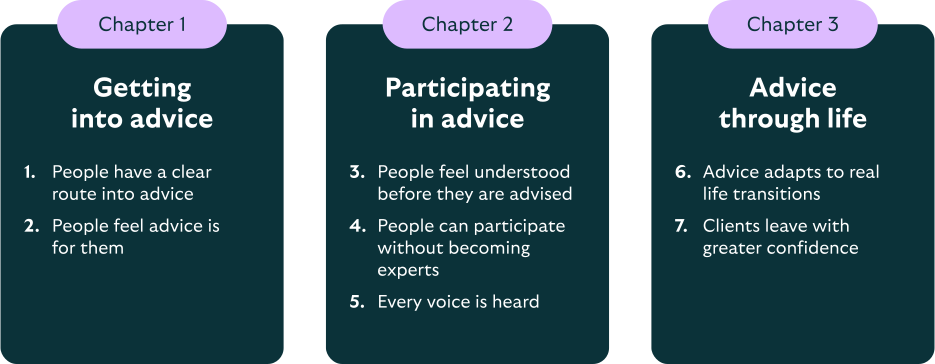
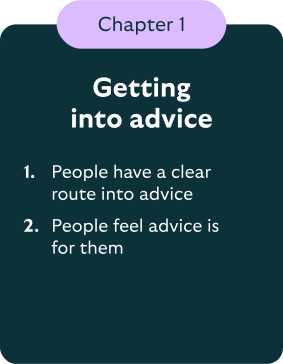
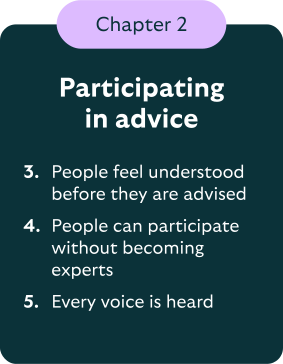
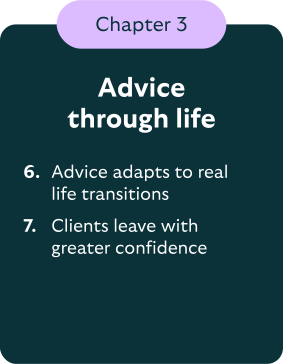
Two participation tests
If we’ve closed the participation gap, would we find:

A woman with £150k sat in cash who has spent three years thinking about finding an adviser but can’t get started?
A woman who has £1m invested with an adviser, but her husband attends all the meetings. He wants to retire at 57: she can’t see how that’s possible for the family and it worries her?
“I feel a bit silly because I know it’s just sitting there and it could be earning more. It’s getting silly now because I’ve been saying this for three years.”
Female non-advised consumer
“When I meet a woman, she will normally say something about, ‘I don’t know enough’, ‘I’ve never really thought about this’, ‘it’s never been my area’, ‘I’m rubbish at maths’.”
Female adviser, 5-10 adviser firm


