Paying dividends

It’s worth remembering the potential for capital gains (upwards price movements) is just one element of the total return from investing in equities – the other element is dividends.
Stocks that pay higher dividends are often thought of as unexciting, usually because they are not in the faster growth market sectors, but dividends can provide a significant element of shareholder returns, which can be particularly helpful in a time of market uncertainty.
Dividends: The 8th wonder?
Albert Einstein reputedly referred to compound interest as `the 8th wonder of the world’. Equity dividend reinvestment has a similar effect to compound interest, by reinvesting the dividend payment to buy more shares to grow the overall holding. As the increased number of shares owned may can appreciate over time, it can lead to more growth in total return and more dividends received (if companies continue to pay them) over time. This underlines the power of long-term investing and the strength of compounding.
One of the easiest ways to appreciate this is to compare the returns from an index with and without dividends reinvested. The figures are stark and get more so the longer the time period.
Take, for example, the MSCI ACWI, a commonly used global equity benchmark. As we can see from the chart below, line A shows returns when dividends are reinvested, producing a return of 519%, compared with line B that just shows the price return of the index, when dividends are not reinvested, and this produces a return of 288% over the 25-year period of this chart.
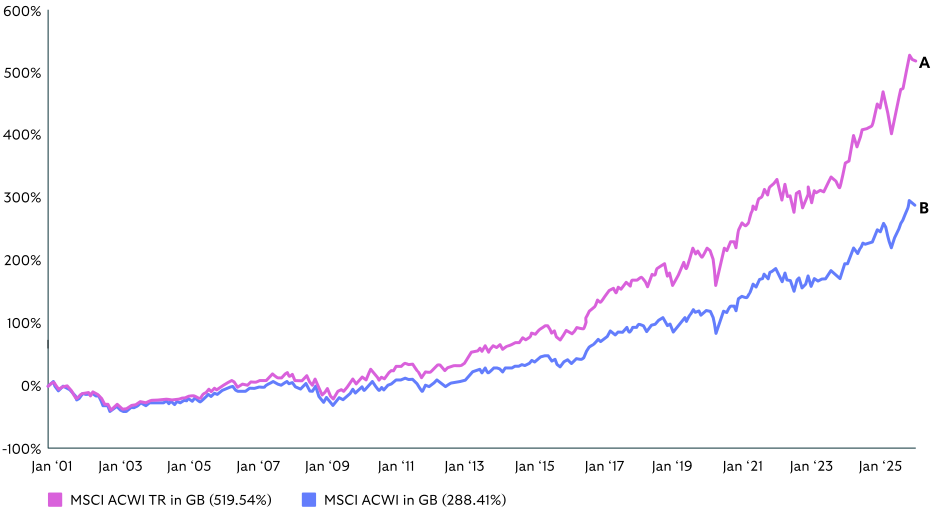
Source: 29/12/2000 – 31/12/2025 Data from FE fundinfo 2026
Albert Einstein reputedly referred to compound interest as `the 8th wonder of the world’.
Dividend yield
Dividend yield is a useful metric of the potential income from an index and is also a helpful valuation tool to measure a market’s worth relative to its past and against other markets. Even after a relatively robust run, the FTSE 100 as at the end of February 2026 had a dividend yield of 2.8%1. (Note that this dividend yield figure is from before the market volatility experienced during March 2026.) This is annual dividends paid by all the companies in the index as a percentage of the total market capitalisation of the index. This is a helpful measure of likely income from holding the shares in the index, assuming that share prices don’t move, and dividends are maintained at the same levels – so for a £100 holding in a FTSE 100 investment vehicle, £2.80 would be the likely expected dividend. Although dividends can fall or be stopped altogether, generally speaking, dividend payouts from companies rise through time and over the long term, share prices tend to rise too. If share prices rise faster that dividend growth, then the yield will fall as a percentage of the market capitalisation of the index.
Some final thoughts
We don’t know where interest rates and bond yields are going in the short term, amid current market turmoil on the back of the conflict in Iran. However, dividends tend to garner greater appreciation in a world of lower interest rates, economic downturns, tumultuous markets or low-growth periods. As part of a diversified portfolio with a mix of equities, bonds and other investments, dividends can provide a relatively robust element of the total return from the equity portion.
Source: FE Analytics.
1 FTSE Russel Factsheet, FTSE 100, as at 27 February 2026.