


Scenario Modelling: Time to increase default contribution rates?

It seems certain that more money will need to go into our private pensions system. However, household balance sheets, business balance sheets and the national balance sheet remain hard pressed. Reaching a consensus as to where new money could come from will therefore be challenging.
Beyond an increase in the State Pension, higher retirement incomes can come from either saving for longer or from higher contribution rates. We use the NRF to assess the impact of two specific options:
- Increase in contribution rates. We assess the effect of a rise in contributions from 8% to 12% on the first £30k of salaries, the first £50k of salaries and total salaries for those that currently contribute to DC pensions below the 12% rate.
- Increase in time worked. We assess the effect of a making contributions for five additional years, for those who are currently contributing to DC schemes.
These changes would affect those already covered by automatic enrolment. Those who opt out, who have incomes below the minimum threshold or who are self-employed or indeed unemployed would not be covered. Wider reforms, including bringing the self-employed into automatic enrolment, are required to fully address the challenges of providing good retirement outcomes.
This year’s report is published at a time of renewed focus on pensions policy, including through the Pensions Commission. While we examine retirement outcomes across all age groups, we focus particularly on those under 30, since policy changes have the greatest scope to affect their outcomes over the course of their working life. No comparable policy change is likely to have a large effect on people already close to retirement.
Retirement outcomes depend on how pensions work with wider personal finance
First, it’s worthwhile to note that people with the lowest retirement incomes rely overwhelmingly on the State Pension. Private pensions make only a limited contribution at the lower end, showing that pension pots alone will not be enough to deliver adequate retirement incomes for everyone.
As retirement incomes rise, private pensions become more important, but so do inheritance and other savings. Better retirement outcomes therefore depend not just on pensions themselves, but on wider personal finances. This demonstrates that while raising contributions can play a crucial role for the many already building their private pension, as we discuss below, policy could also place greater emphasis on improving the interoperability of pensions with other assets and support, including savings, housing equity, guidance and advice.
Higher retirement incomes rely on a wider mix of income sources
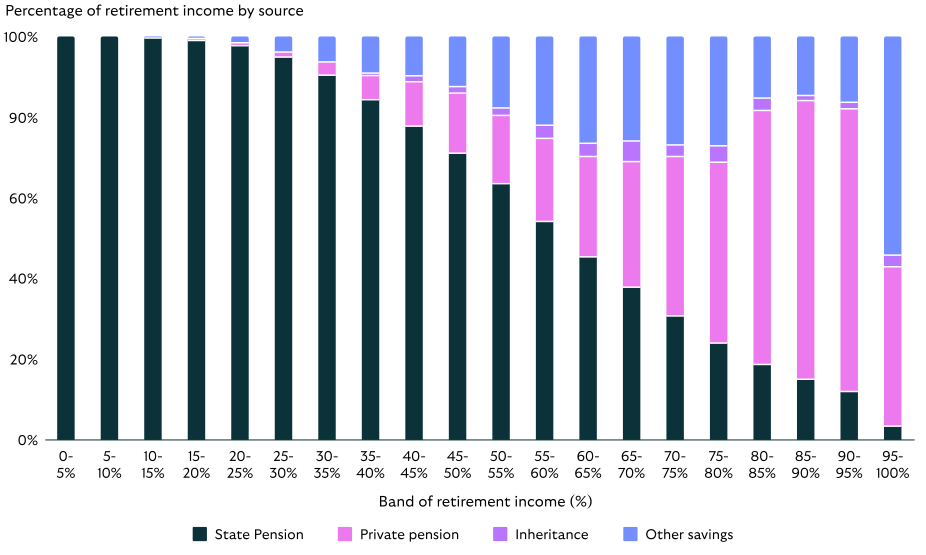
First, it’s worthwhile to note that people with the lowest retirement incomes rely overwhelmingly on the State Pension.”
Increasing default contribution rates would substantially increase pension pots
We find that increasing default contribution rates would have a sizable impact on the pension pots of those currently saving. Increasing total contribution rates from 8% to 12% on the first £30k of salaries would lead to an average increase in projected pension pots at retirement of £40k. Extending this AE increase to the first £50k of salaries would lead to an increase of £55k and further extending it to total salaries would lead to increase of £65k.
Our statistics indicate that 40% of AE contributors earn £30k or less, a further 40% earn between £30k and £50k and 20% earn £50k+. Therefore, all DC contributors would benefit from total contribution rates rising to 12% on the first £30k, 60% would benefit further from the increase extending from £30k to £50k, and 20% would benefit if the uplift was extended from the first £50k to total salaries.
Increasing default contribution rates has the largest impact on the size of pension pots for younger people
The chart shows the increase in projected pension pot at retirement by age band for DC members contributing at or below new proposed AE levels. In modelling the uplift in contributions, we assume that the current ratio of 3:5 employer vs employee split is unchanged. We therefore assume the additional pension contributions from the reforms are funded by 38% employers, 47% employees and 15% tax relief.
The impact of increases to contribution rates are much larger for younger people who have more years of retirement saving ahead of them. For those 22-29, currently saving below 12%, the average increase in pension pot at retirement would be £114k if total contribution rates were increased from 8% to 12% on the first £30k of salaries. This average increase in pension pots would be £155k if total contribution rates were increased on the first £50k of salaries and rise to an increase of £195k if it were applied to total salaries.
This increase could be crucial as we expect those who have just started saving to have greater outgoings in retirement, with a higher proportion paying high private rents or carrying mortgages through retirement. They are also least likely to hold other pension assets such as being a member of a defined benefit (DB) pension scheme.

Increasing default contributions would substantially decrease pension poverty
Under a scenario where AE contribution rates were increased to 12% on the first £30k of salaries, 5% of DC members contributing below these AE rates would be lifted out of pension poverty (a fall of 24% to 19%). If AE contribution rates were increased to 12% on the first £50k of salaries or on total salaries then further decreases in pension poverty are modest to 18% and 17%, respectively.
The equivalent decrease in pension poverty for the under-30s DC members contributing below 12% currently is more substantial. Pension poverty would more than half from 32% to 14% for this group if AE contribution rates were increased to 12% on the first £50k. Applying the 12% uplift across total salaries would bring pension poverty down a little further to 13%. We can see that the impact of AE changes diminishes for older cohorts as they have fewer savings years to benefit from the change.
Increasing Automatic Enrolment contributions would reduce pension poverty substantially for DC members, especially those in younger groups
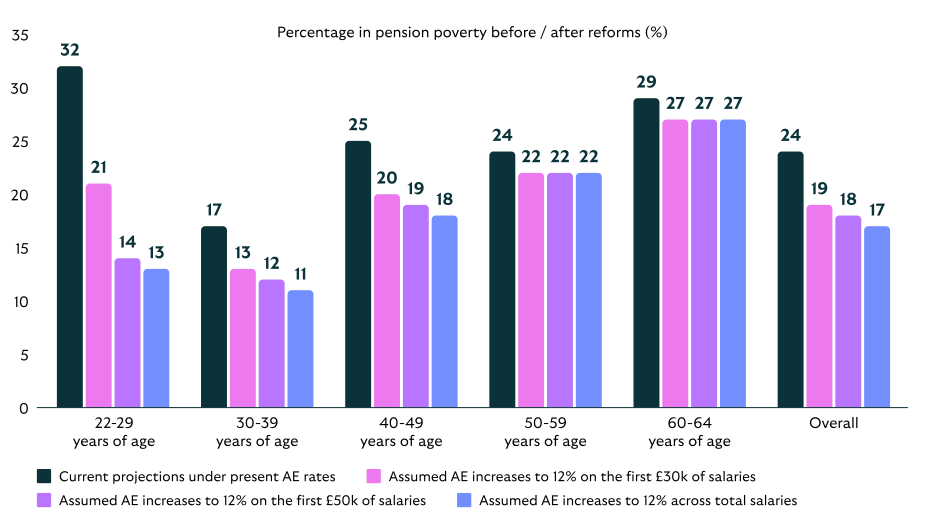
The chart shows the decrease in pension poverty before and after AE reforms by age band for DC members contributing at AE rates. In modelling the uplift in contributions, we assume that the current ratio of 3:5 employer vs employee split is unchanged. We therefore assume the additional pension contributions from the reforms are funded by 38% employers, 47% employees and 15% tax relief.
Increasing default contributions is more impactful than contributing for longer
We use the NRF to understand retirement outcomes if savers contributed to their DC pension for five more years. We find that, for DC members under 30 who are currently contributing below 12% to their pension, contributing five more years to a DC pension at current rates would reduce pension poverty from 32% to 26% (6 percentage points reduction). This decrease is three times smaller than the equivalent decrease (18%) in pension poverty associated with increasing AE contributions to 12% on the first £50k of salaries.
Working an extra five years has a smaller impact than all AE reform scenarios for those under 30
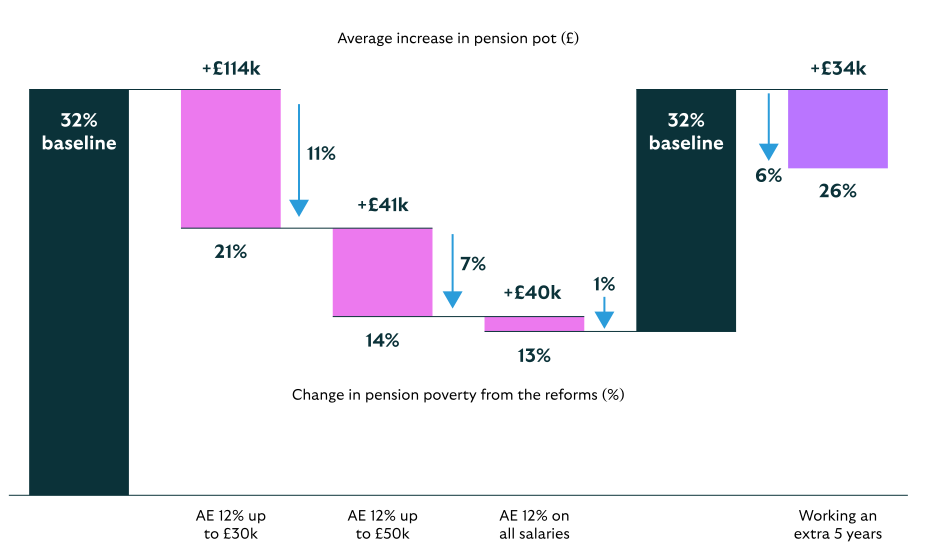
The chart shows the decrease in pension poverty before and after AE reforms for DC members between 22-30 contributing at or below AE rates.
Our modelling suggests that extending working lives can improve retirement outcomes, but that its effect is modest relative to higher contributions for younger savers. For DC savers under 30, working for an additional five years would increase average pension wealth by around £34k. By comparison, increasing contribution rates from 8% to 12% on earnings up to £50k would increase average pension wealth by around £155k. As a broad rule of thumb, for younger savers five additional years of pension saving is roughly equivalent to around a 1 percentage point increase in auto-enrolment contributions.
There are also wider reasons to be cautious about relying too heavily on longer working lives as the answer to the retirement adequacy challenge. Previous Scottish Widows research has shown how career breaks can interrupt contribution patterns and weaken retirement prospects, particularly for women. More broadly, some younger people face barriers to entering employment and training, missing out on important early years of pension saving. At the other end of working life, remaining in work may not be straightforward for everyone, whether because of health constraints or because suitable employment is harder to find, as we discuss later in this report.
Taken together, this suggests that policies focused solely on extending working lives are unlikely to be sufficient to address the pension adequacy challenge, particularly for younger savers, unless they are accompanied by measures that increase pension contributions.
Next – we look at how people are balancing living today whilst saving for tomorrow.


