Physical AI is about to reshape our world

Key highlights
- Physical artificial intelligence (AI) combines advanced robotics with artificial intelligence to create autonomous systems that can perform complex tasks in dynamic, real-world environments.
- Applications like autonomous vehicles and industrial automation are moving into mainstream adoption, unlocking new markets and making measurable gains in efficiency, safety and performance.
- Sitting at the intersection of multiple secular trends (AI, automation, edge computing and digital transformation), we believe physical AI represents a generational opportunity for long-term investors.
Physical AI isn’t coming, it’s here
Physical AI- the convergence of robotics and artificial intelligence—is no longer a theoretical concept. It’s a rapidly scaling force reshaping how machines interact with the physical world. From autonomous vehicles and robotic surgery to smart factories and logistics, physical AI is unlocking new levels of precision, adaptability and efficiency.
We see physical AI as a foundational technology with the potential to transform multi-trillion- dollar industries. Its impact will be measured not only in productivity gains, cost savings and margin expansion, but also by establishing a new paradigm for how technology becomes infused on our physical world.
Physical AI will be a cornerstone of the next industrial era.
What is physical AI?
Physical AI refers to intelligent systems that can perceive, reason and act in real-world environments. These systems combine advanced robotics with AI models, enabling machines to make decisions and execute tasks with speed and precision—often in milliseconds.
Unlike traditional AI, which operates in digital environments, physical AI translates code into real-world motion. These systems are equipped with sensors, actuators and edge computing capabilities that allow them to adapt dynamically to changing conditions. The result— machines that can operate autonomously in complex, unstructured settings.
Exhibit 1: How it works – advanced robotics enabled by Edge Computing

Why it matters now
Physical AI is moving from early-stage experimentation to real-world deployment, and it’s already delivering measurable value. A few examples include:
- Mobility: Powering the shift toward autonomous transportation
- Manufacturing: Enhancing productivity and reducing waste
- Service economy: Addressing labor shortages and improving quality of life
As adoption accelerates, we expect physical AI to become a core enabler of operational efficiency, safety and scalability across the global economy. Consider three industries already seeing meaningful value-generation driven by physical AI.
Mobility: autonomous vehicles drive multi-trillion-dollar shift
Autonomous driving is one of the most visible—and investable—applications of physical AI. In the United States, ride-hailing platforms have logged over 100 million fully driverless miles in cities like San Francisco, Phoenix and Austin. In China, over 14 million robotaxi rides have been completed across 16 cities.1 In some markets, consumers have even shown a willingness to pay a premium for an autonomous ride versus a traditional rideshare with a driver, and high customer satisfaction scores imply a high likelihood of further adoption.
Safety was long promised as a key element of the value proposition for autonomous vehicles, but there is now data to back it up; in one study, a leading service provider noted significantly lower crash rates relative to human drivers.
By 2030, Level 3 autonomous vehicles (AV) could account for 10% of global new car sales.2 Under accelerated adoption scenarios, autonomous driving passenger revenues could be between US$300-US$400 billion by 2035.3 This shift will also drive demand across the AV ecosystem—from semiconductors and edge computing to mapping, insurance analytics and software-defined vehicles.
Exhibit 2: The opportunity from the AV Ecosystem

We expect physical AI to become a core enabler of operational efficiency, safety and scalability across the global economy.
Manufacturing: AI-driven efficiency as a competitive advantage
Physical AI is radically transforming manufacturing by embedding intelligence into every stage of production. We think four key areas of innovation stand out: humanoid robots, collaborative robots (Cobots), autonomous mobile robots (AMRs), and AI-based computer vision.
Exhibit 3: Physical AI in manufacturing
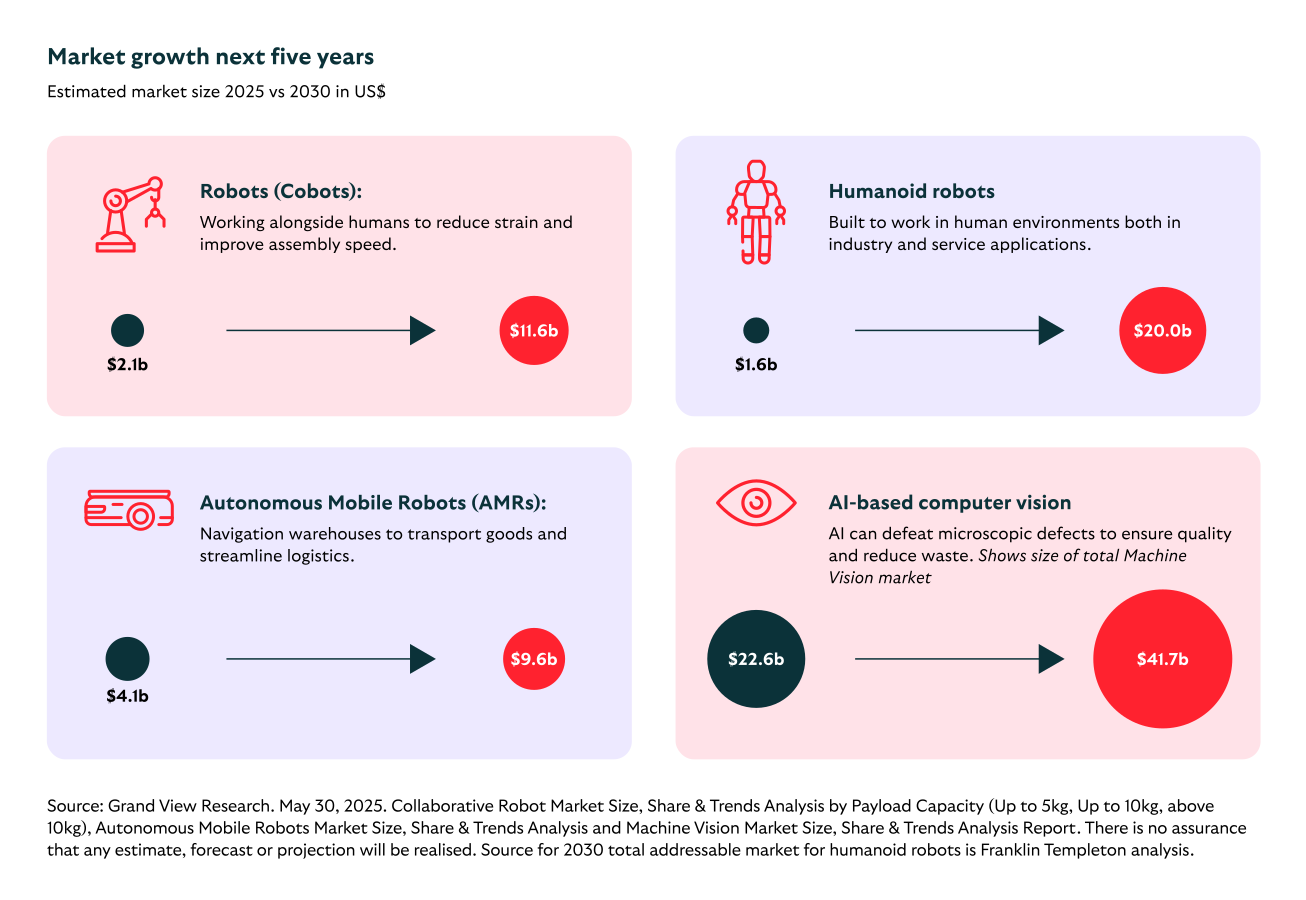
Humanoid robots, which are designed to mimic human appearance and behavior, represent a new and promising iteration of autonomous physical systems. While we’re in the very early stages of adoption, humanoids are already being deployed in manufacturing facilities. The humanoid form factor is ideal for operating in complex environments that were built for human workers. Increasingly, they are powered by purpose-built AI models known as vision- language-action (VLA) models, which enable the robots to better understand their environment and have a more generalizable, rather than task-specific, skill set. VLA models and other innovations can drive progress on what is known in the AI community as Moravec’s Paradox: what is easy for humans (perception and basic motor skills) is hard for computers, and what is hard for humans (complex math, abstract reasoning) is easy for computers. Additionally, recent breakthroughs in areas like autonomous battery swapping ensure robots can continue working around the clock with limited human intervention.
These new technologies will improve safety, profit margins, and factory yield. Potential beneficiaries span the value chain, from robotics and vision-system providers to semiconductor and AI software firms that are building the “brain” for robots.
Exhibit 4: Humanoid robots on the factory floor

The service economy: addressing labor shortages and improving quality of life
While the technology is still emerging, we believe physical AI is poised to permeate the service economy as costs decline; for example, state-of-the-art models that cost US$250,000 per unit in 2023 had dropped to US$150,000 in 20244. AI-powered robots can take on essential tasks across health care services, restaurants, hospitality and retail. For instance, humanoids can assist with the distribution of medicines or room turnover in hospitals. They can handle dishes, linens and trash runs at hotels and restaurants. These roles are often hard to staff and maintain, making the prospect of always-on robots especially compelling.
We’re also tracking breakthroughs that enable robots to understand complex instructions and perform series of generalizable tasks. These advancements could open up the broader consumer market, where intelligent robots could become valuable household assistants.
Many families would appreciate having an intelligent robot to assist with daily chores and logistics.
The investment case for physical AI
We are still in the early innings, but in our mind, the trajectory is clear. Physical AI will be a cornerstone of the next industrial era. It represents the convergence of automation, edge computing, AI and digital transformation, and we believe it will create a generational opportunity for long-term investors.
As adoption scales, we expect to see:
- Recurring revenue models (e.g., per-mile and subscription AV services, robot hardware leases plus software and services)
- Cross-sector demand (health care, logistics, manufacturing, retail)
- Ecosystem growth (hardware, software, data infrastructure)
Physical AI is not just a technological evolution—it’s a paradigm shift in how machines interact with the world. We believe it can offer long-term investors durable growth and a powerful and differentiated source of long-term alpha.
Endnotes
1 Source: The Robot Report. July 18, 2025. Waymo reaches 100M fully autonomous miles across all deployments.
2 Source: Goldman Sachs, August 19, 2024. Partially autonomous cars forecast to comprise 10% of new vehicle sales by 2030. There is no assurance that any estimate, forecast or projection will be realized.
3 Source: McKinsey and Company. January 3, 2023. Autonomous driving’s future: Convenient and connected. Level 3 autonomous vehicles (L3 AVs), as defined by the SAE International (J3016) automation scale, are “conditionally automated” driving systems. It can handle all aspects of the driving task in certain conditions but must be available to take over when requested by the vehicle. There is no assurance that any estimate, forecast or projection will be realized.
4 Source: Goldman Sachs. February 27, 2024. The global market for humanoid robots could reach $38 billion by 2035. There is no assurance that any estimate, forecast or projection will be realized.
What are the risks?
All investments involve risks, including possible loss of principal.
Equity securities are subject to price fluctuation and possible loss of principal.
Small- and mid-cap stocks involve greater risks and volatility than large-cap stocks.
Investment strategies which incorporate the identification of thematic investment opportunities, and their performance, may be negatively impacted if the investment manager does not correctly identify such opportunities or if the theme develops in an unexpected manner. Focusing investments in the health care, information technology (IT) and/or technology-related industries carries much greater risks of adverse developments and price movements in such industries than a strategy that invests in a wider variety of industries.
Any companies and/or case studies referenced herein are used solely for illustrative purposes; any investment may or may not be currently held by any portfolio advised by Franklin Templeton. The information provided is not a recommendation or individual investment advice for any particular security, strategy, or investment product and is not an indication of the trading intent of any Franklin Templeton managed portfolio.
Important information
This material is intended to be of general interest only and should not be construed as individual investment advice or a recommendation or solicitation to buy, sell or hold any security or to adopt any investment strategy. It does not constitute legal or tax advice. This material may not be reproduced, distributed or published without prior written permission from Franklin Templeton.
The views expressed are those of the investment manager and the comments, opinions and analyses are rendered as at publication date and may change without notice. The underlying assumptions and these views are subject to change based on market and other conditions and may differ from other portfolio managers or of the firm as a whole. The information provided in this material is not intended as a complete analysis of every material fact regarding any country, region or market. There is no assurance that any prediction, projection or forecast on the economy, stock market, bond market or the economic trends of the markets will be realized. The value of investments and the income from them can go down as wellas up and you may not get back the full amount that you invested. Past performance is not necessarily indicative nor a guarantee of future performance. All investments involve risks, including possible loss of principal.
Any research and analysis contained in this material has been procured by Franklin Templeton for its own purposes and may be acted upon in that connection and, as such, is provided to you incidentally. Data from third-party sources may have been used in the preparation of this material and Franklin Templeton (“FT”) has not independently verified, validated or audited such data.
Although information has been obtained from sources that Franklin Templeton believes to be reliable, no guarantee can be given as to its accuracy and such information may be incomplete or condensed and may be subject to change at any time without notice. The mention of any individual securities should neither constitute nor be construed as a recommendation to purchase, hold or sell any securities, and the information provided regarding such individual securities (if any) is not a sufficient basis upon which to make an investment decision. FT accepts no liability whatsoever for any loss arising from use of this information and reliance upon the comments, opinions and analyses in the material is at the sole discretion of the user.
Franklin Templeton has environmental, social and governance (ESG) capabilities; however, not all strategies or products for a strategy consider “ESG” as part of their investment process.
Products, services and information may not be available in all jurisdictions and are offered outside the U.S. by other FT affiliates and/or their distributors as local laws and regulation permits. Please consult your own financial professional or Franklin Templeton institutional contact for further information on availability of products and services in your jurisdiction.
Brazil: Issued by Franklin Templeton Investimentos (Brasil) Ltda., authorized to render investment management services by CVM per Declaratory Act n. 6.534, issued on October 1, 2001. Canada: Issued by Franklin Templeton Investments Corp., 200 King Street West, Suite 1400 Toronto, ON, M5H3T4, Fax: (416) 364- 1163, (800) 387-0830, www.franklintempleton.ca.. Offshore Americas: In the US, this publication is made available by Franklin Templeton, One Franklin Parkway, San Mateo, California 94403-1906. Tel: (800) 239-3894 (USA Toll-Free), (877) 389-0076 (Canada Toll-Free), and Fax: (727) 299-8736. US: Franklin Templeton, One Franklin Parkway, San Mateo, California 94403-1906, (800) DIAL BEN/342-5236, franklintempleton.com. Investments are not FDIC insured; may lose value; and are not bank guaranteed.
Issued in Europe by: Franklin Templeton International Services S.à r.l. – Supervised by the Commission de Surveillance du Secteur Financier – 8A, rue Albert Borschette, L-1246 Luxembourg. Tel: +352-46 66 67-1, Fax: +352 34 2080 9861. Poland: Issued by Templeton Asset Management (Poland) TFI S.A.; Rondo ONZ 1; 00-124 Warsaw. Saudi Arabia: Franklin Templeton Financial Company, Unit 209, Rubeen Plaza, Northern Ring Rd, Hittin District 13512, Riyadh, Saudi Arabia. Regulated by CMA. License no. 23265-22. Tel: +966-112542570. All investments entail risks including loss of principal investment amount.
South Africa: Issued by Franklin Templeton Investments SA (PTY) Ltd, which is an authorized Financial Services Provider. Tel: +27 (21) 831 7400, Fax: +27 10 344 0686. Switzerland: Issued by Franklin Templeton Switzerland Ltd, Talstrasse 41, CH-8001 Zurich. United Arab Emirates: Issued by Franklin Templeton Investments (ME) Limited, authorized and regulated by the Dubai Financial Services Authority. Dubai office: Franklin Templeton, The Gate, East Wing, Level 2, Dubai International Financial Centre, P.O. Box 506613, Dubai, U.A.E. Tel: +9714-4284100, Fax: +9714-4284140. UK: Issued by Franklin Templeton Investment Management Limited (FTIML), registered office: Cannon Place, 78 Cannon Street, London EC4N 6HL. Tel: +44 (0)20 7073 8500. Authorized and regulated in the United Kingdom by the Financial Conduct Authority.
Australia: Issued by Franklin Templeton Australia Limited (ABN 76 004 835 849) (Australian Financial Services License Holder No. 240827), Level 47, 120 Collins Street, Melbourne, Victoria 3000. Hong Kong: Issued by Franklin Templeton Investments (Asia) Limited, 62/F, Two IFC, 8 Finance Street, Central, Hong Kong. Japan: Issued by Franklin Templeton Investments Japan Limited. Korea: Issued by Franklin Templeton Investment Advisors Korea Co., Ltd., 3rd fl., CCMM Building, 101 Yeouigongwon-ro, Yeongdeungpo-gu, Seoul, Korea 07241. Malaysia: Issued by Franklin Templeton Asset Management (Malaysia) Sdn. Bhd. & Franklin Templeton GSC Asset Management Sdn. Bhd. This document has not been reviewed by Securities Commission Malaysia. Singapore: Issued by Templeton Asset Management Ltd. Registration No. (UEN) 199205211E, 7 Temasek Boulevard, #26-03 Suntec Tower One, 038987, Singapore.