


There’s more to growth than AI

For many of the past several years, investor enthusiasm has been concentrated in a narrow group of AI-related and technology stocks. As liquidity conditions tighten and speculation begins to recede, broader market fundamentals are gaining importance. In his July insight, Richard Bernstein, Global Head of Macro & Customized Investing, examines how improving profit growth across regions and sectors is creating opportunities beyond the market’s recent leaders.
Speculation continues to be the defining attribute of today’s financial markets. As evidence, investors continue to equate the financial markets and the prediction markets despite those markets’ vastly different economic purposes.
The financial markets exist for capital formation and real business investment in plants, equipment, and employment. These markets are the economic link between the classic equivalence of savings and investment.
The prediction markets, however, exist purely to make a bet on any outcome, with virtually no economic value added.
Excess liquidity is the lifeblood of speculation, and the primary custodian of excess liquidity is the Federal Reserve. The Fed potentially needing to raise interest rates to fight inflation could eventually cause the end of the current speculative fervor. As the old saying goes, “the Fed takes the punchbowl away from the party”.
Our view at the beginning of 2026 was that investor expectations were too optimistic regarding how much and how frequently the Fed would cut rates. In other words, liquidity would not be flowing as abundantly as speculators anticipated.
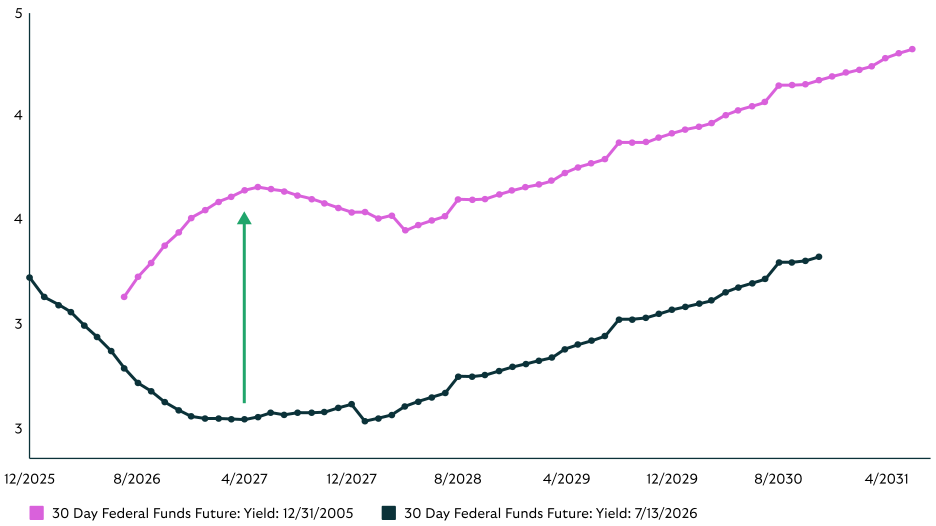
Exhibit 1 demonstrates that investors have reconsidered their year-end 2025 Fed forecasts and have indeed started to price in liquidity drying up.
Exhibit 1: 30-day federal fund futures, December 31, 2025 vs July 13, 2026
Source: RBA and Janus Henderson Investors, Bloomberg Finance L.P.
Without excess liquidity, fundamentals again matter…
Our research over the past 30-plus years has shown that market rotations (i.e., shifts between growth/value, large/small, high quality/low quality) are based on profits cycles and valuation fundamentals. When markets ignore fundamentals, it is typically because excess liquidity drives speculation and momentum and relative strength dominate performance rather than profits and valuation.
Many have commented about the U.S. economy’s “resilience”, and nominal growth has surprised during 2026. However, fewer have noted that the nominal economy’s strength has led to stronger and broader profits growth. More companies are growing both in and outside the U.S.
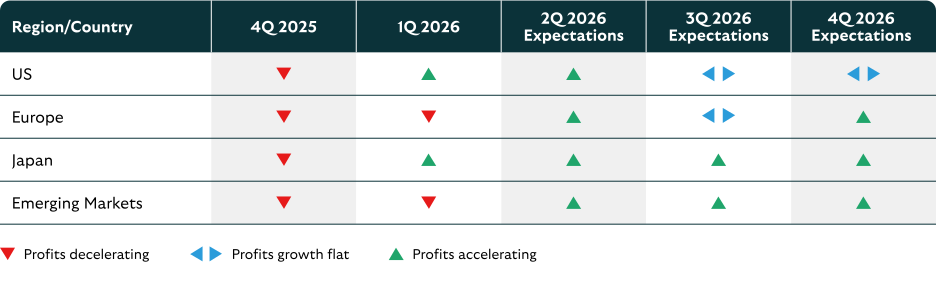
Exhibit 2 shows our profits cycle forecasts for major regions. U.S. profits growth is not bad, but the cycle does appear to be slowly peaking. However, non-U.S. cycles seem to be accelerating, implying that U.S. and non-U.S. profits growth is starting to converge.
The bull case for non-U.S. stocks was for several years almost purely based on those regions’ undervaluation. The lack of a growth story constrained their outperformance. Today, non-U.S. markets offer growth that is increasingly competitive with the U.S., and their performance so far during 2026 reflects that improved profitability.
Exhibit 2: International markets poised for profit acceleration
Source: RBA and Janus Henderson Investors, MSCI, Bloomberg Finance, S&P Global, as of June 30, 2026.
Excess liquidity is the lifeblood of speculation, and the primary custodian of excess liquidity is the Federal Reserve.”
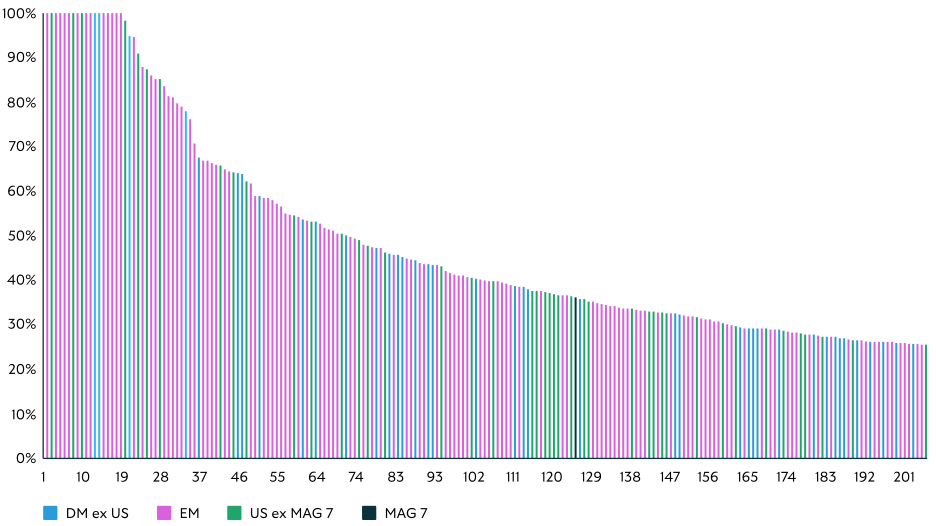
One might suggest that the U.S. is the only market offering long-term profits growth, but that isn’t true at all. Exhibit 3 shows the projected long-term growth rates for every stock in the ACWI Index with projected growth greater than 25%.
Probably surprising to most investors, the group includes only one of the so-called Magnificent 7 stocks, and the multi-colored bars demonstrate that long-term growth is available around the world.
Exhibit 3: ACWI Long-term 5-year consensus EPS growth estimates >25%
Source: RBA/JHI, FactSet, as of July 10, 2026.
…and performance is again beginning to reflect broadly improving profits
Investors scoffed at our suggestion that the stock market could rotate away from the momentum-driven AI and technology theme without a bear market. However, that has indeed been 2026’s story so far.
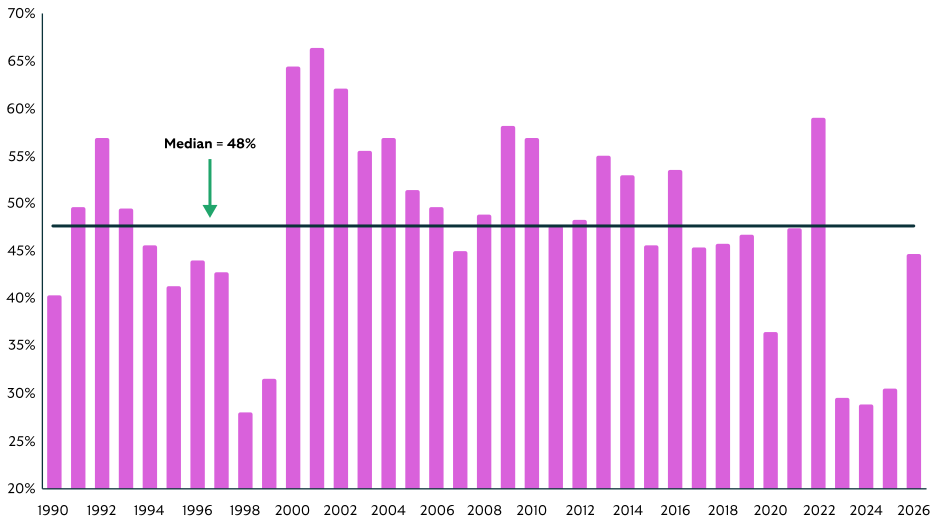
Exhibit 4 shows the percentage of stocks by year within the S&P 500 that outperformed the index. The years 2023 to 2025 marked the narrowest period for the stock market in the past 35 years, and the recent narrowness persisted for longer than the Technology Bubble in 1998/99.
So far, the market has broadened during 2026, reflecting the reduction in speculative liquidity and improving fundamentals. Although the market has broadened, 2026’s market is still less broad than the long-term median breadth. Because most investors still seem fixated on the momentum stocks of the past several years despite the changing liquidity and profits backdrops, it is possible that we are still in the early stages of a longer-term broad market advance.
Exhibit 4: S&P 500® Index: Percentage of stocks that outperformed the index (1990 to June 2026 price returns)
Source: Janus Henderson Investors, BofAML US Strategy, as of June 30, 2026.
Our research over the past 30-plus years has shown that market rotations are based on profits cycles and valuation fundamentals.”
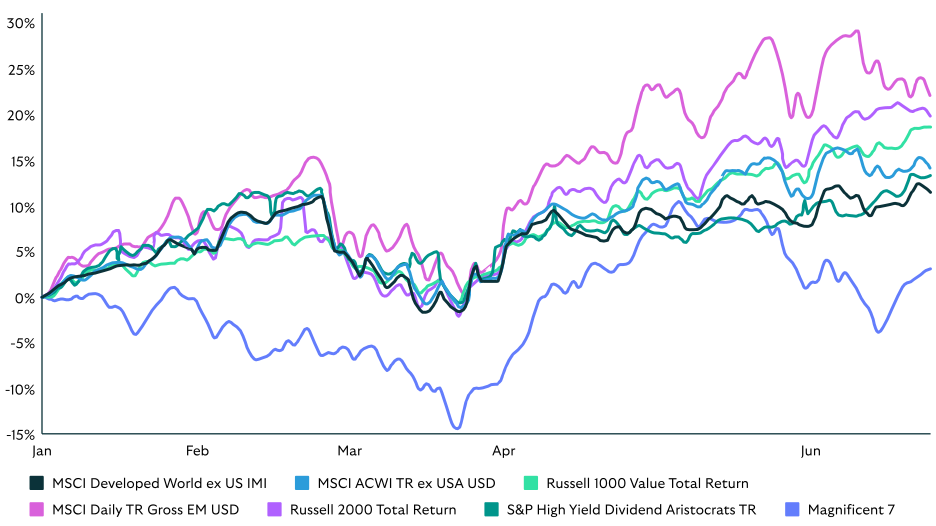
Exhibit 5 demonstrates that market performance during the first half of 2026 has been globally broad. The chart compares the total return performance of five broad U.S. and global indices, all of which have meaningfully outperformed the Magnificent 7 stocks.
Exhibit 5: Market leadership is expanding beyond the Magnificent 7 (YTD as of June 30, 2026)
Source: Bloomberg Finance, as of June 30, 2026.
Boring is beautiful: Follow fundamentals, not the hype
If we are correct and inflation forces the Fed to continue to reduce economic liquidity and profits continue to improve and broaden, then stocks with shorter durations and those with improving and underappreciated fundamentals might continue to outperform.
Our 2026 theme, Boring is Beautiful, focusing primarily on dividends and non-U.S. stocks, still seems prudent.
The views presented are as of the date published. They are for information purposes only and should not be used or construed as investment, legal or tax advice or as an offer to sell, a solicitation of an offer to buy, or a recommendation to buy, sell or hold any security, investment strategy or market sector. Nothing in this material shall be deemed to be a direct or indirect provision of investment management services specific to any client requirements. Opinions and examples are meant as an illustration of broader themes, are not an indication of trading intent, are subject to change and may not reflect the views of others in the organization. It is not intended to indicate or imply that any illustration/example mentioned is now or was ever held in any portfolio. No forecasts can be guaranteed and there is no guarantee that the information supplied is complete or timely, nor are there any warranties with regard to the results obtained from its use. Janus Henderson Investors is the source of data unless otherwise indicated, and has reasonable belief to rely on information and data sourced from third parties. Past performance does not predict future returns. Investing involves risk, including the possible loss of principal and fluctuation of value.
Not all products or services are available in all jurisdictions. This material or information contained in it may be restricted by law, may not be reproduced or referred to without express written permission or used in any jurisdiction or circumstance in which its use would be unlawful. Janus Henderson is not responsible for any unlawful distribution of this material to any third parties, in whole or in part. The contents of this material have not been approved or endorsed by any regulatory agency.
Janus Henderson Investors is the name under which investment products and services are provided by the entities identified in Europe by Janus Henderson Investors International Limited (reg no. 3594615), Janus Henderson Investors UK Limited (reg. no. 906355), Janus Henderson Fund Management UK Limited (reg. no. 2678531), Tabula Investment Management Limited (reg. no. 11286661), (each registered in England and Wales at 201 Bishopsgate, London EC2M 3AE and regulated by the Financial Conduct Authority) and Janus Henderson Investors Europe S.A. (reg no. B22848 at 78, Avenue de la Liberté, L-1930 Luxembourg, Luxembourg and regulated by the Commission de Surveillance du Secteur Financier).
Outside of the U.S.: For use only by institutional, professional, qualified and sophisticated investors, qualified distributors, wholesale investors and wholesale clients as defined by the applicable jurisdiction. Not for public viewing or distribution. Marketing Communication.
Janus Henderson® and any other trademarks used herein are trademarks of Janus Henderson Group Ltd. or one of its subsidiaries. © Janus Henderson Group Ltd.


