


Why the Middle East crisis hasn’t derailed the emerging market recovery

Despite heightened geopolitical risk, many emerging market economies are in good shape and valuations remain attractive.
As markets digested the impact of the first waves of conflict in Iran, the focus quickly moved onto energy and commodity prices and what they would mean for the global economy. Emerging markets have not been immune to negative sentiment but we think investors may be overlooking the fact that many of these economies export important natural resources. We believe the long-term case for a recovery in emerging markets is still intact and recent price weakness could even signal a buying opportunity.
How geopolitical crises impact sentiment
When geopolitical crises occur, investors are inclined to react, seek comfort and sell high-risk assets. This is precisely what we witnessed in March. Emerging markets tend to be sold indiscriminately in risk-off periods but this time, we think an additional factor was at play: profit taking after a period of strong performance.
The question investors are now grappling with is whether this will be a short lived, flash-in-the-pan conflict or whether it might become more protracted and therefore more detrimental to the global economy.
So far, energy has been a key area of focus. The Middle East remains central to oil supply and price reactions have been swift. Areas of concern include Cuba, where natural gas prices are rising rapidly, and parts of Asia, which import a lot of commodities.
Interestingly, we have seen China behave more like a safe haven. Despite being a net energy importer, China has been prudent about building up reserves, meaning its economy is more resilient to these types of shocks.
Another lightening rod for investor sentiment is the dollar, a traditional safe haven. In the short term, the dollar weakening story that acted as powerful tailwind for emerging markets may have paused.
While we don’t take strong views on currencies, the dollar is expensive relative to history. It could strengthen from here but we think it is unlikely to repeat its exceptional post-financial crisis run and therefore, we don’t expect it to be such a strong headwind going forward. By contrast, emerging market currencies look exceptionally cheap.
Why the investment case for emerging markets is as strong as ever
Recent events have not changed the medium to long-term outlook for emerging markets, in our view – although clearly in the near term, there is a need to be flexible and account for risks.
Infrastructure investment remains a key driver in several regions. Government debt is a factor here; debt levels in many emerging market economies are materially lower than in developed markets, so governments have more headroom for infrastructure investment and fiscal stimulus.
In countries such as Brazil and South Africa, high real interest rates have helped to stabilise currencies and inflation, creating scope for policy easing and domestic recovery.
Commodity prices are increasing due to robust demand and tight supply, leading to better pricing power and higher profitability. Copper, cobalt, lithium and nickel are all crucial for the tech sector, the energy transition and electrification.
Another theme is self-sufficiency; the middle classes are becoming wealthier and domestic consumption is driving growth.
Corporate fundamentals are improving
In the months preceding the Iran crisis, profit forecasts rose significantly for companies in the MSCI Emerging Markets index1, which marks a step change compared with previous years. The tide is turning from a quality and balance sheet perspective as well. An abundance of companies in emerging markets have net cash on their balance sheets and many of them have a high return on equity.
Companies are making sensible capital allocation decisions across China, Korea and Eastern Europe and in the financial, materials and energy sectors. In China, we are starting to see companies buying back shares aggressively on depressed valuations.
All this good news is not yet priced in. Most emerging markets still trade at a meaningful discount to developed markets and to their own history, despite last year’s strong performance. In Brazil, for example, there is no shortage of companies where the valuation is lower than the dividend yield. And in China, it is possible to achieve a large margin of safety through selective stock picking.
Valuations by region
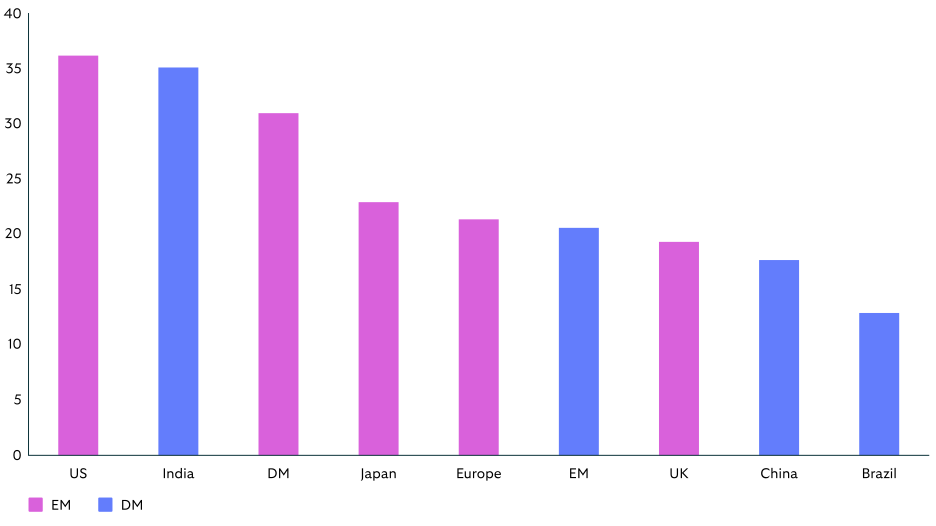
Source: Bloomberg as at 31 January 2026. The chart above shows the Shiller P/E, which is the long-term price-to-earnings ratio computed by dividing price by 10-year average real earnings per share (EPS). Real earnings per share is computed by adjusting the EPS ratio for the country’s consumer price index (CPI).
The bottom line is that across emerging market economies today, plenty of businesses are cheap, with good profitability, strong cashflow generation and a propensity to distribute income to shareholders. These companies also stand to benefit from a range of tailwinds, from stronger commodity prices to government stimulus.
1 Artemis for the three months ending 28 February 2026
FOR PROFESSIONAL INVESTORS AND/OR QUALIFIED INVESTORS AND/OR FINANCIAL INTERMEDIARIES ONLY. NOT FOR USE WITH OR BY PRIVATE INVESTORS. This is a marketing communication. Before making any final investment decisions, and to understand the investment risks involved, refer to the fund prospectus and KIID/KID, available in English and in your local language (depending on local country registration), from the relevant fund page or literature section on www.artemisfunds.com. The documents can also be found on www.fundinfo.com.
CAPITAL AT RISK. All financial investments involve taking risk and the value of your investment may go down as well as up. This means your investment is not guaranteed and you may not get back as much as you put in. Any income from the investment is also likely to vary and cannot be guaranteed.
Investment in a fund concerns the acquisition of units/shares in the fund and not in the underlying assets of the fund.
The fund is a sub-fund of Artemis Investment Funds ICVC. For further information, visit www.artemisfunds.com/oeic.
Any research and analysis in this communication has been obtained by Artemis for its own use. Although this communication is based on sources of information that Artemis believes to be reliable, no guarantee is given as to its accuracy or completeness.
Third parties (including FTSE and MSCI) whose data may be included in this document do not accept any liability for errors or omissions. For information, visit www.artemisfunds.com/third-party-data.
Reference to specific shares or companies should not be taken as advice or a recommendation to invest in them.
Any forward-looking statements are based on Artemis’ current expectations and projections and are subject to change without notice.
Issued by Artemis Fund Managers Ltd which is authorised and regulated by the Financial Conduct Authority.


