


Energy security and investment risk – how investors can build resilience

Recent geopolitical developments have placed energy security at the centre of policy discussions across Europe and beyond. Previously, energy security became a central concern for policymakers, investors, and consumers following Russia’s invasion of Ukraine in 2022. This exposed vulnerabilities in global supply chains and triggered worries about access, affordability and the inflationary impact of rising prices.
And while progress has been made – such as diversifying supply sources and advancing the energy transition to renewable, low carbon sources – reliance on fossil fuel markets continues to leave the global economy exposed.
How this translates to investment risk
Energy security is about having a reliable, affordable supply of energy. When energy security is weak, it can create real and material risks for investors across markets, sectors and regions. From an investment perspective, energy security matters because energy underpins economic activity, inflation, corporate profitability and geopolitical stability. Energy is a foundational input into most economic activity. When energy supply is constrained or prices rise sharply inflation typically increases, central banks can tighten monetary policy meaning borrowing costs rise and economic growth can slow.
Investments concentrated in energy-import-dependent regions may face slower growth, higher fiscal pressure and political instability. Then there is sector-specific risk. Energy-intensive industries like manufacturing, transport and chemicals could face margin pressures. Utilities may face regulatory caps that limit profits. Returns can diverge sharply between sectors, increasing the importance of diversification.
The effects of the current disruption on energy supply and costs have been significant. The particular dependency of the Asia-Pacific region on energy supplies transiting through the Strait of Hormuz has seen governments in many countries bring in widespread measures aimed at alleviating supply pressures. These include shorter working weeks, early closure of retail outlets, limits on private transport and travel, and support for vulnerable industries and consumers. Across the western world, it’s led to higher fuel and energy prices, and declining business1, investor and consumer confidence.
The economic and financial risks are clear – lower productivity, higher costs and greater uncertainty. It creates a challenging environment for investors and highlights the need for robust risk management and systemic changes to help mitigate the risk of energy insecurity.
Bringing stability to energy supplies
The volatility in global energy markets, exacerbated by conflicts and shifting alliances, has prompted governments, businesses and investors to reassess their strategies for reliable energy supply.
We saw a similar reaction in 2022. As a result, energy security across Europe has improved somewhat. Steps to achieve this included:
- the EU’s diversification of its energy supply through increasing imports of liquefied natural gas. While this circumvented dependency on Russia, supplies are largely from the US and Qatar, which has led to some disruption and volatility in the wake of the current crisis.
- record investments in renewable energy infrastructure, including wind, solar, and battery storage, with half of the EU’s electricity generated by renewables.
- an emphasis on maintaining high gas storage levels, and
- more interconnected national grids.
In 2025, solar and wind produced more power than fossil fuels in the European Union
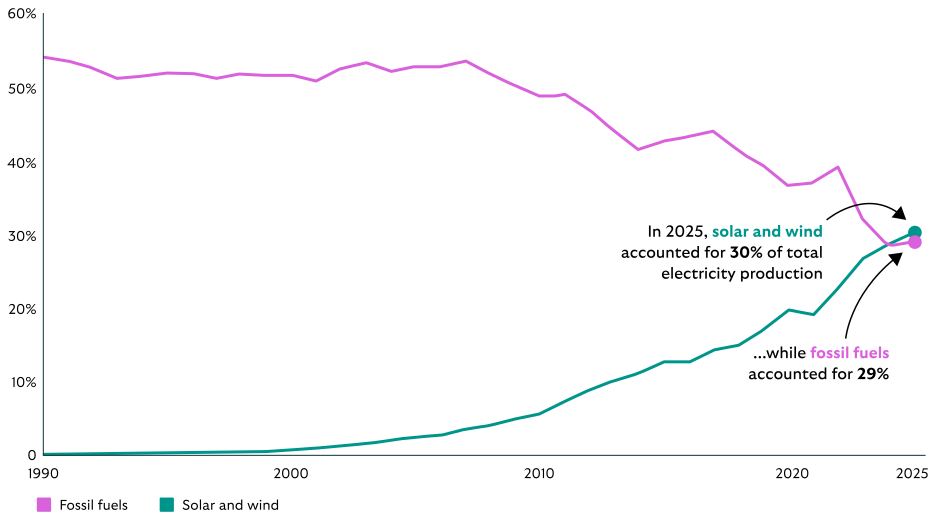
Sources: Our World in Data, Ember (2026).
Note: In 2025, 24% of electricity came from nuclear, and 17% from other renewables.
In the UK, the debate around domestic energy production has gained renewed significance as stakeholders seek to balance economic imperatives with sustainability goals.
Reliance on fossil fuel markets continues to leave the global economy exposed.
Domestic oil versus imported oil
The North Sea has long been a strategic asset for the UK and its neighbours, providing a source of domestic oil that reduces reliance on imports from politically unstable regions. Proponents argue that maintaining or expanding North Sea production enhances national energy security, potentially offering a buffer against supply disruptions and price shocks. Critics, however, point out that supplies would be traded globally and would therefore go to the highest bidder rather than be protected for the UK market. There are also questions about the environmental implications and long-term viability of continued fossil fuel extraction, particularly as global efforts to address climate change intensify.
As it stands, the UK government pointed out in March 2026 that: “Regardless of where it comes from, the price of oil and gas is determined by international markets, not the UK. We are price-takers, not price-makers… New licences to explore new fields wouldn’t make any difference to the prices set by international markets and paid by UK billpayers.”2
The economic implications of domestic oil compared with imported alternatives are multifaceted. Domestic production supports local employment, contributes to government revenues through taxation and royalties, and stimulates ancillary industries. However, the costs associated with extraction particularly in a mature basin like the North Sea, regulatory compliance, and potential environmental remediation must also be considered.
Imported oil, while sometimes cheaper on a per-barrel basis, exposes the economy to currency fluctuations, logistical risks, and geopolitical tensions that can disrupt supply chains and inflate costs. A balanced approach requires weighing these direct and indirect impacts and the overall economics of supply to ensure long-term resilience.
Investment in renewables
Against this backdrop, investment in renewable energy sources may present a compelling alternative. Renewables such as wind, solar, and tidal power offer the promise of greater energy independence, reduced carbon emissions, and alignment with international climate commitments. The initial capital outlay for renewables can be substantial, but ongoing operational costs are typically lower, and the sector benefits from technological innovation and economies of scale.
Importantly, renewables are less vulnerable to geopolitical shocks, making them a strategic asset in the pursuit of energy security. More than just a ‘green initiative’, renewables could prove a key energy security stabiliser.
However, unlocking cheaper energy from renewables is not only a question of building new generation capacity. In the UK, wholesale electricity prices are still often set by the marginal cost of gas-fired generation, which means households and businesses can face high prices even when a growing share of power comes from low-cost wind and solar. The government’s Review of Electricity Market Arrangements (REMA) and wider market reforms aimed at reducing the automatic pass-through from gas to power prices (while preserving investment signals) could help ensure the economic benefits of renewables are reflected in bills.
In addition, there are a number of practical and regulatory barriers in the UK that can keep energy costs higher than they need to be, even as renewable generation expands. These include slow planning processes, delays in grid connections and network constraints, skills shortages, and slow pass through to bills due to issues such as standing charges, supplier hedging and price caps.
Financial materiality and ESG standards
In the energy sector these policy, regulatory and market-structure factors are often highly material – frequently shaping company strategy and performance through their impact on costs, project economics, capital allocation and the stability of revenues. Reforms can be complex and slow-moving, but that complexity is precisely why they cannot be ignored in financial analysis, valuation assumptions and investment strategy.
Firms leading the transition to renewables and implementing robust ESG frameworks, however, may attract significant capital, gain enhanced stakeholder trust, and demonstrate adaptability in turbulent markets.
The value of responsible investing goes beyond the energy sector. By better understanding and managing the risks associated with the transition to net zero, such as changes in policy, demand and markets as economies are decarbonising; physical risks linked to more extreme weather events, increasing temperatures; and geopolitical shocks, we can create more resilient investment portfolios.
Responsible investment, underpinned by rigorous Environmental, Social, and Governance (ESG) standards, has emerged as a key consideration for investors. Financial materiality – ensuring that ESG factors have a tangible impact on returns – has become central to investment decision-making.


