


Happy Birthday, MSCI World!

Amadeo Alentorn celebrates the 40-year anniversary of MSCI World Index.
The MSCI World Index, launched on 31 March 1986, has, over four decades, been one of the most important and widely used benchmarks for developed market equities. It provides investors with a transparent, rules-based framework to track the performance of developed world equity markets. We wish the MSCI World Index a very happy 40th birthday!
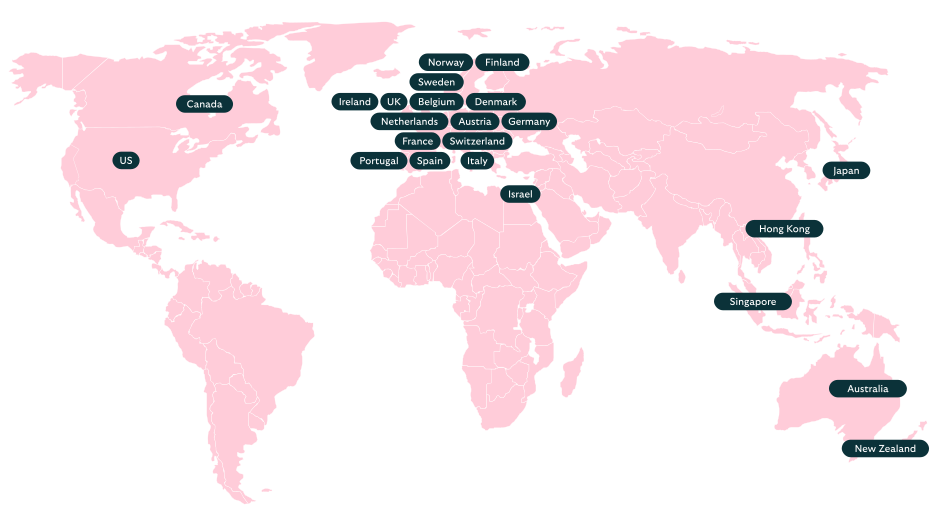
It should be noted that the MSCI World Index, despite its universal-sounding name, excludes emerging markets. MSCI has a detailed classification methodology for what counts as a developed market, including gross national income per capita, size, liquidity and market accessibility.
Countries included in the MSCI World Index
The exclusion of emerging markets from the MSCI World Index led MSCI, on 31 May 1990, to create a new index, the MSCI ACWI, which includes them. MSCI did not stop there: today it offers more than 12,000 different indices of great scope and detail, representing a monumental achievement in the history of measuring financial markets.
One should not assume that indices are always calculated in the same way throughout their history. In the early 2000s, MSCI changed the MSCI World Index from a full market cap weighting to a free float-adjusted weighting (see MSCI, 2000). The free float (also called public float) represents the shares of a company that are owned by public investors as opposed to locked-in shares. This transition meant that government holdings and strategic stakes were excluded, making the MSCI World more investable and more reflective of accessible and liquid equity supply.
Despite these exclusions, the capitalisation of the MSCI World Index is gigantic: US$85,270,435,000,000 as at 27 February 2026. That’s more than US$85 trillion. (The MSCI ACWI is of course even larger, at US$97 trillion.) The ability of developed market companies, especially, to raise capital through public equity markets has, of course, been one of the most important reasons for the developed world’s relative prosperity in modern history, compared to pre-industrial times.
MSCI World Index market cap | US$85.27 trillion
A diversified index
The MSCI World Index includes around 1,320 large- and mid-cap companies across 23 developed markets and covering approximately 85% of investable market capitalisation. While the US remains dominant (with a 70% weight, as at 27 February 2026), the MSCI World’s inclusion of non-US equities offers meaningful diversification through exposure to differing regional economic cycles, sector compositions, and central bank policy environments.
Importantly, global developed markets provide a broader opportunity set beyond the US, with its technology-heavy structure. As at 27 February 2026, the Information Technology sector accounted for 25% of the MSCI World Index, compared to 32% in the MSCI USA Index. That is nearly one third higher and represents a significant increase in sector risk for the MSCI USA Index compared to the more-diversified MSCI World Index.
The MSCI World Index includes regions that offer greater exposure to financials, industrials and cyclicals (see table.) In our view, this results in a more balanced sector profile than the MSCI USA Index (and the S&P 500) and reduces reliance on a narrow cohort of mega-cap technology stocks.
MSCI World offers greater diversification than MSCI USA
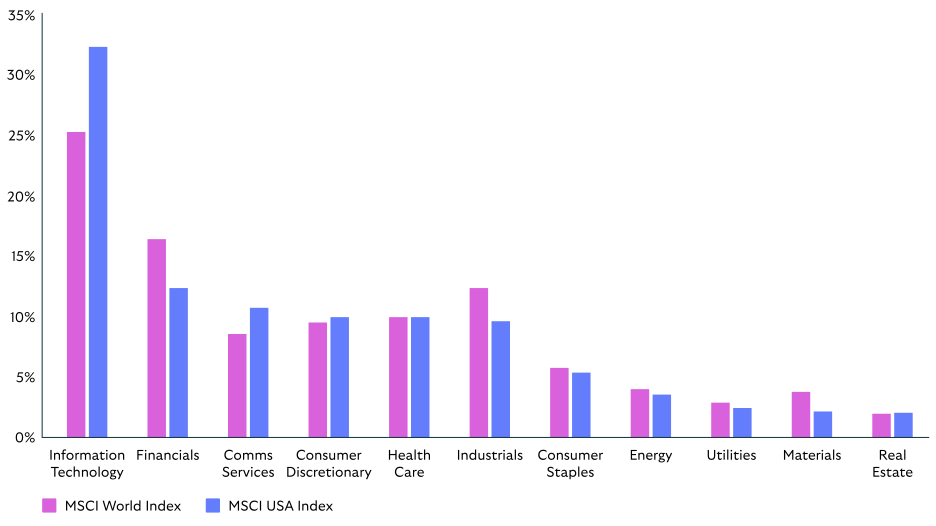
Sources: MSCI, Jupiter at 27 February 2026. Sector splits of MSCI World versus MSCI USA.
More attractive valuations outside the US
From a valuation perspective, global equities currently appear relatively more attractive than US equities. While headline multiples for the MSCI World Index remain elevated, non-US markets currently trade at meaningful discounts, supporting the case for geographic diversification. (See chart.)
The Price Earnings Ratio of US equities has become higher than global developed equities
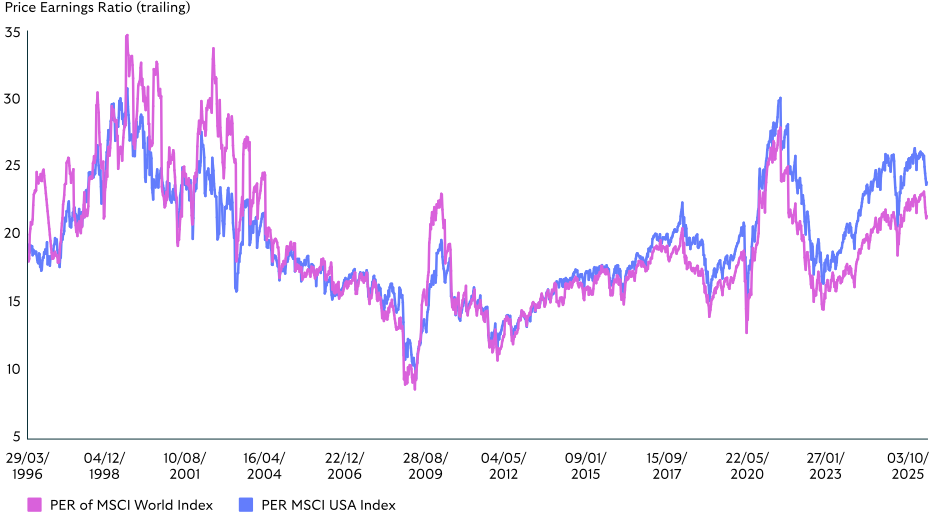
Sources: Bloomberg as at 29 March 2026. Trailing Price Earnings Ratio of MSCI World versus MSCI USA.
A global equity approach provides investors with access to diversified sources of return across regions, sectors and factors, enhancing portfolio resilience and broadening the opportunity set beyond a US-centric framework.
What is an index?
One may think of an index as a lens through which to view the market. A financial index is a statistical composite. It is not the entire market. The Dow Jones Industrial Average (DJIA), for example, only includes 30 stocks. The MSCI includes about 1,320, but that is only a fraction of all the traded equities in the world. There are about 50,000 publicly listed companies in the world, according to the World Federation of Exchanges (2026).
Since the MSCI World Index tracks about 2.6% of the world’s publicly traded companies, can it be said to be representative? Financial markets are very top-heavy, with a long tail of relatively tiny companies. The MSCI World Index explicitly targets only large- and mid-cap equities in 23 developed market countries.
The most important property of an index is its weighting scheme. There are three main weighting methodologies in use:
- Market-capitalisation weighting. The MSCI World, and many other famous indices, such as the S&P 500, follow this scheme. Companies are weighted in the index by their total market value. Large companies, such as NVIDIA or Apple, drive the movement of a market cap-weighted index much more than small stocks do. What is being measured by a market-cap index is a representation of the aggregate wealth of the market.
- Price weighting. The DJIA is a price-weighted index. Companies are weighted by their share price. A stock trading at US$100 has ten times the influence on this kind of index as a stock trading at US$10. This method is seen as antiquated because the price of one share does not matter except in relation to its total capitalisation.
- Equal weighting. The S&P 500 Equal Weight Index (EWI) is an example, where all 500 companies are allocated the same weight (0.2%) regardless of their size. Each company in the index has the same influence.
Indices are scaled using a mathematical constant, called a divisor. The constructor of the index ensures that corporate events such as stock splits do not artificially spike (or crash) the index value.
For those, like us, who value the scientific method, it is worth comparing indices with physical measurement scales such as temperature. In physics, temperature is not a measure of a single particle; it is the macroscopic expression of the average kinetic energy of millions of microscopic molecules bouncing around. Similarly, a financial index is the macroscopic expression of the average price movement of millions of individual shares changing hands based on the localised energy (buying and selling pressure) of market participants. Both metrics allow observers to gauge the overall state of a complex system without having to measure every individual component.
Unlike temperature, which has a physical reality governed by the laws of thermodynamics, an index is a human-engineered construct designed to measure or sample a financial market, an economic system consisting of a multitude of bargains struck between large numbers of individual investors and market participants. Market indices are subjective in other ways too. For example, the membership and rules of an index are decided by a company or committee and may be amended over time. Temperature has an absolute zero (0 degrees Kelvin) which corresponds to all kinetic energy having ceased. An index reaching zero would imply the bankruptcy of all its members.
…An index is a human-engineered construct designed to measure or sample a financial market, an economic system consisting of a multitude of bargains struck between large numbers of individual investors and market participants.
The history of indices
The first market index was the Dow Jones Average, which began on 3 July 1884. It was invented by Charles Dow, a financial journalist, and his business partner Edward Jones. They also co-founded The Wall Street Journal. Dow wanted a single number he could print in his daily bulletin, the Customer’s Afternoon Letter. The Dow Jones Average began with just 11 stocks. Nine of them were railroad companies. Concentration in one sector is not unique in history!
Financial markets go much further back than the first index. When John Castaing began publishing The Course of the Exchange and Other Things from Jonathan’s Coffee House in London in 1698, there was no concept of a market average. He listed prices of diverse instruments, such as shares in the Bank of England (then a private company), or the East India Company, the price of a British government bond and exchange rates.
The very first global equities index was the Capital International World Index, alongside its sister benchmark, the Capital International EAFE Index (Europe, Australasia, and the Far East), both launched in 1968. This was a period of economic expansion. Globalisation was accelerating, and institutional investors (particularly large US pension funds) were beginning to look outside of North America for returns.
In 1986, the investment bank Morgan Stanley licensed the rights to the index data from Capital International. They combined the names, officially rebranding the benchmarks as the Morgan Stanley Capital International (MSCI) indices. MSCI became a standalone public company in 2007.
Today, almost every national stock market has an index. The Royal Securities Exchange of Bhutan, for example, tracks its 18 listed companies via the Bhutan Stock Index (BSI). However, the Cape Verde Stock Exchange (Bolsa de Valores de Cabo Verde) has only four listed equities, and no index; sensibly so, because it is simpler just to look at the four prices.
Decades of growth, punctuated by crises
Since the MSCI World Index was launched, on 31 March 1986, it has gained more than 1,200%. That is despite a series of geopolitical crises. This is worth bearing in mind when considering the long-term impact of current crises. As we write this, the conflict between the US and Israel and Iran has entered its second month. Our thoughts are with all our clients and their families in the region.
The closure of the Strait of Hormuz has led to a sharp increase in oil prices, causing volatility across markets.
There has almost always been a reason not to invest in risk assets. Reviewing the last four decades, investors have always had plenty of reasons to worry. Dangerous political, military, economic and financial events seem almost inevitable (see chart).
MSCI World Index since 31 March 1986
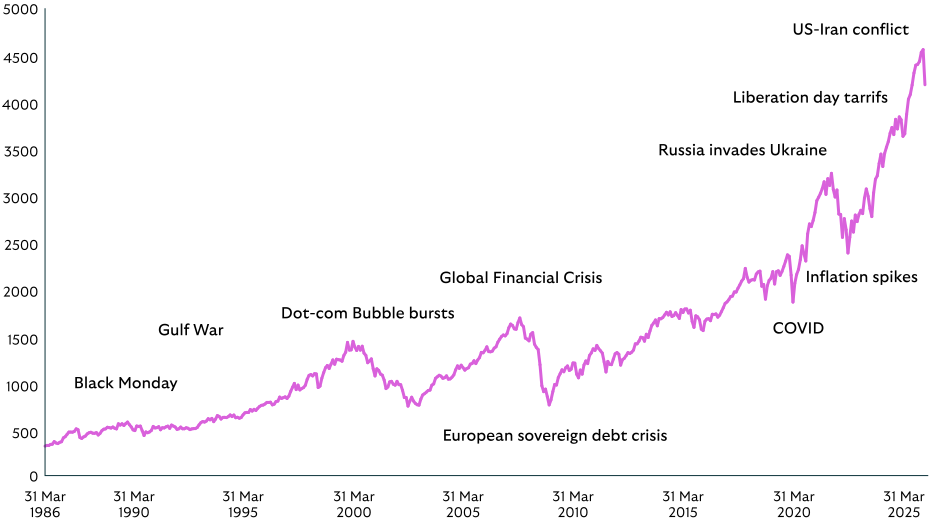
Past performance does not predict future returns.
Source: Refinitiv, Jupiter, as at 27 March 2026.
Over individual one-year periods, equity returns are frequently negative. In fact, the occurrences of negative one-year holding periods were 28.4%, during the history of the MSCI World Index, since 31 March 1986 (MSCI World Index data without dividends).
For longer holding periods, the picture improves. For 3-year holding periods, the occurrence of a negative return reduces to 19.8%. Over 10-year holding periods, the occurrences of losses were low, only 7.2%, historically for the MSCI World Index since 31 March 1986.
MSCI World Index since 31 March 1986
| Holding Period | Positive Occurrences (%) | Negative Occurrences(%) |
|---|---|---|
| 1 year | 71.6 | 28.4 |
| 3 years | 80.2 | 19.8 |
| 10 years | 92.8 | 7.2 |
Past performance does not predict future returns.
Source; Refinitiv, Jupiter, as at 27 March 2026. MSCI World Index (price return, dividends not included) since 31 March 1986, monthly data.
MSCI (2000). MSCI to adjust for free float and to increase coverage to 85%. Geneva, December 10, 2000. Available at https://www.msci.com/eqb/pressreleases/archive/20001210_pr01.pdf
World Federation of Exchanges (2026). Website available at https://www.world-exchanges.org/


