


Stronger support for unpaid carers can help protect pension saving

Women are more likely to take on adult care and to provide more of it
Unpaid care is part of working life for millions of people, both women and men. Women are more likely to provide it, more likely to change how they work as a result and often spend longer away from paid employment. Better support for carers can therefore help protect both earnings today and pension saving for the future.
The gender gap in unpaid care is widest for adult care. More than two in five (42%) women have regularly cared for or supported an adult, compared with around three in 10 (31%) men. Women are also more likely to take care of regular childcare than men (46% vs 38%) and additional care for children with support needs (12% vs 9%).
Women are more likely to provide care throughout working life
Percentage of men and women who currently provide, or have previously provided, each type of unpaid care.
The first financial effect often appears in pay and working patterns
Adult care can require a substantial time commitment. Among adult carers, more than one in five (22%) provided at least 35 hours of care each week, while more than one in four (28%) provided between 10 and 34 hours.
For many women, these demands change how they work. Among women who have provided adult care, two in five (40%) changed their working arrangements because suitable or affordable care was hard to access. More than one-quarter (27%) took time away from work and around one in seven (14%) reduced their hours. Around one in 11 (9%) left paid work or retired earlier than planned, while similar proportions turned down opportunities for progression (9%) or moved to a more flexible or lower-paid role (8%).
Adult care changes work before it reaches pension saving
Women who have provided adult care.
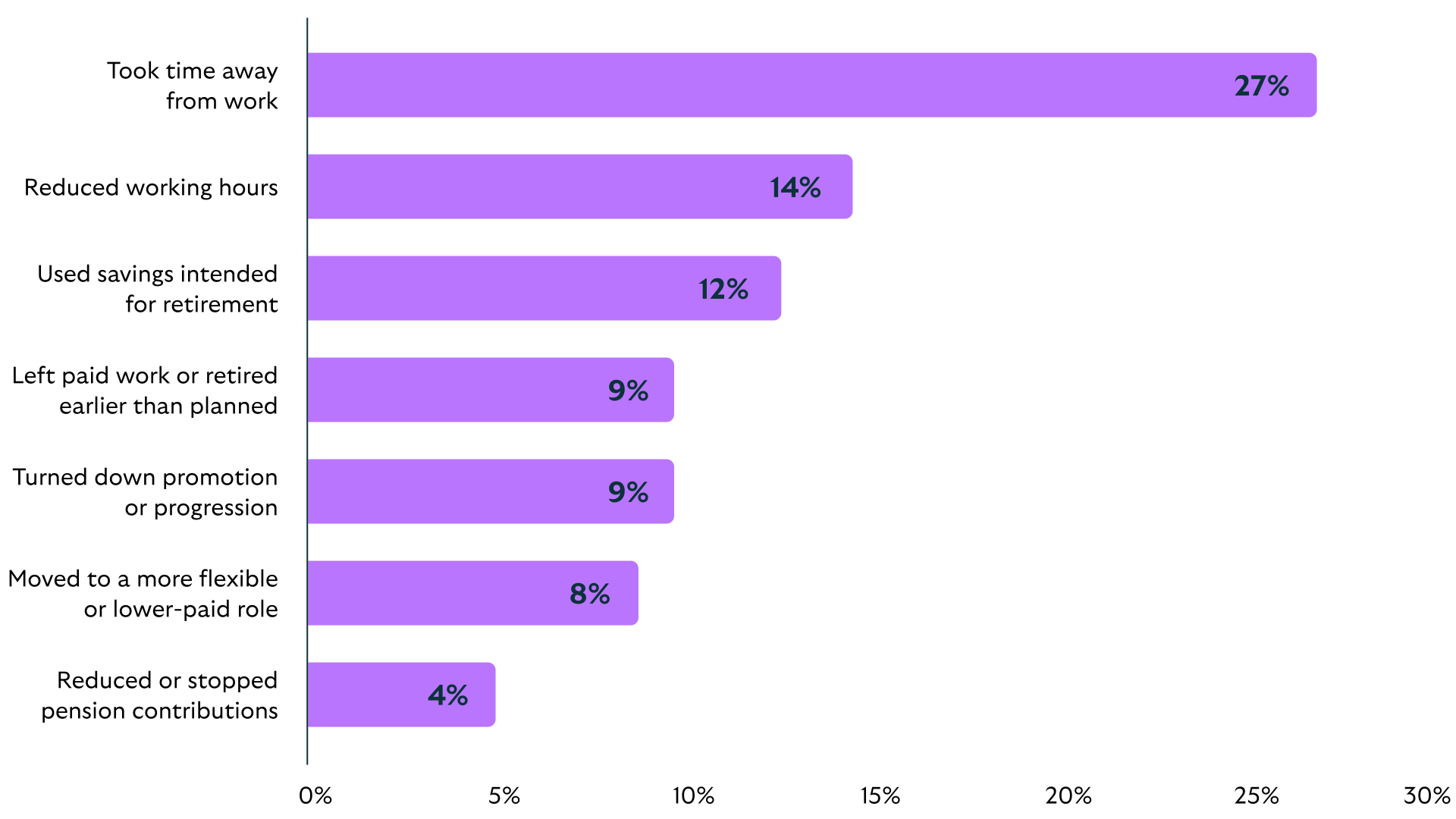
Note: Multiple responses possible, so categories overlap. ‘None of the above’ and ‘Prefer not to say’ are not displayed.
These changes can be long-lasting. Among women who took time away because suitable or affordable adult care was difficult to access, one in five (20%) spent at least a year outside employment and around one in 20 (6%) spent five years or more away.
For some women, the effect also reaches retirement finances directly. Around one in seven (14%) women who have provided adult care reported taking action that affected their retirement finances, including using savings intended for retirement (12%) or reducing or stopping pension contributions (4%).
Existing support can help protect some pension entitlement when carers reduce time spent in paid work. National Insurance credits can protect a carer’s State Pension record, with some awarded automatically through benefits such as Carer’s Allowance and Universal Credit, while other eligible carers may need to apply for Carer’s Credit. There is scope to make better use of this support: among women currently providing regular adult care, only around two-fifths (39%) had heard of the credits and around one in 10 (11%) had claimed or received them.
Adult care can require a substantial time commitment. Among adult carers, more than one in five (22%) provided at least 35 hours of care each week, while more than one in four (28%) provided between 10 and 34 hours.”
Childcare can also interrupt work and pension saving
Childcare can shape women’s retirement prospects by changing how they work, making support that helps parents remain in work and maintain pension saving particularly important. Among those who have provided regular childcare or additional support to a child under 18, half (50%) of women changed how they worked because suitable or affordable childcare was hard to access, compared with 30% of men. The pattern extends across the UK, as the share of women changing how they worked due to lack of affordable childcare exceeded 40% in Scotland and Wales as well as eight of the nine English regions.
Reduced hours and time away from work are two ways these pressures can affect earnings. Among people who have provided childcare, women were more than twice as likely as men to reduce their hours (29% versus 13%), and more than one in five (23%) took time away from paid work, compared with 17% of men. The effect can extend directly to retirement saving: more than one in 10 (13%) women who have provided childcare reduced or stopped pension contributions, used savings intended for retirement, or did both.
Childcare barriers changed women's work across the UK
Share making at least one employment change because suitable or affordable childcare was hard to access. UK average: 50%.
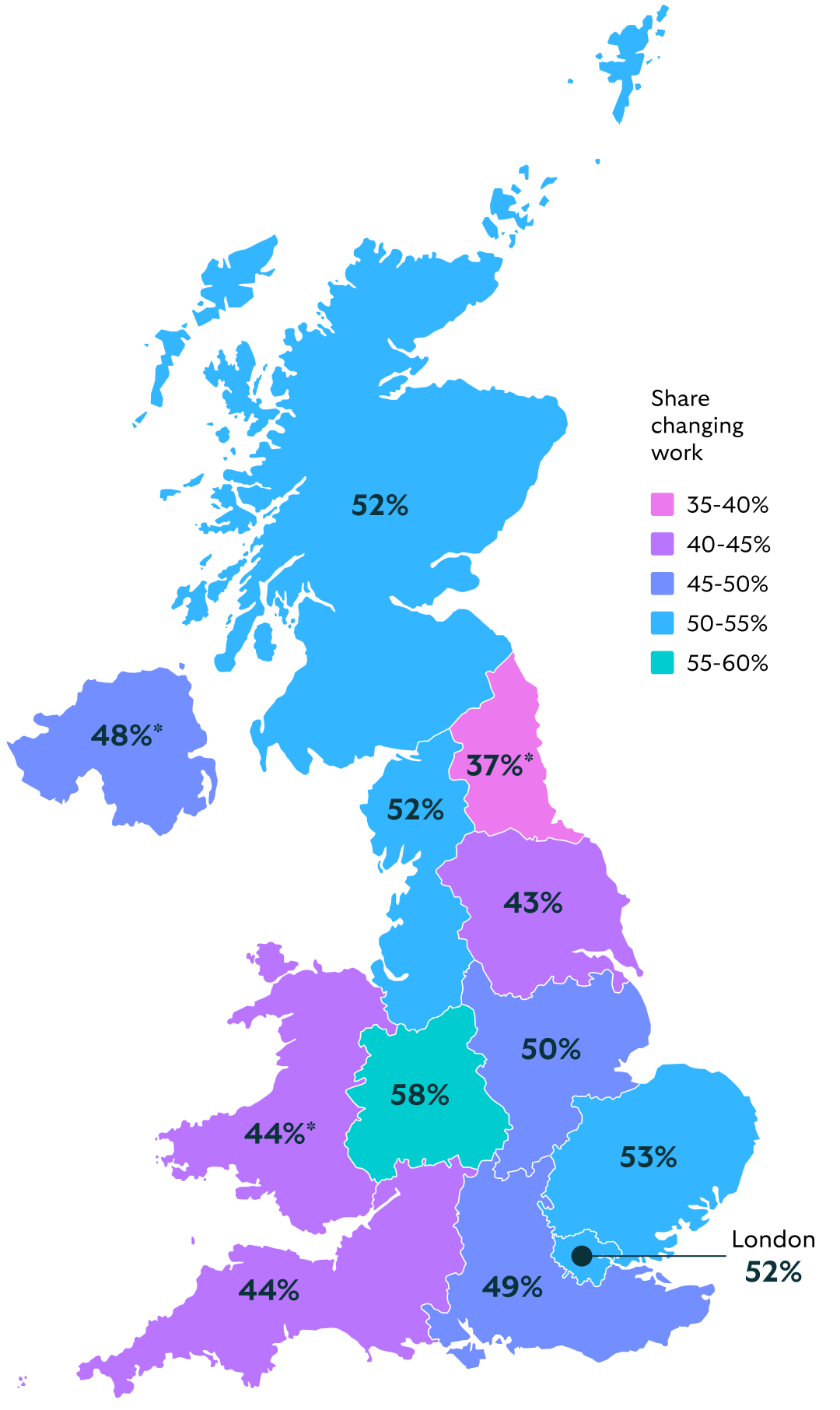
* Unweighted base below 75. Percentages are weighted.
Base: woman who have provided regular childcare or additional support to a child under 18.
Beyond the immediate impact on earnings and pension contributions, childcare responsibilities can also affect women’s longer-term career prospects. Around one in five (19%) women moved to a more flexible or lower-paid role, compared with 9% of men. Around one in six (16%) women turned down an opportunity for progression, against one in 10 (10%) men.
These choices are often made in the context of wider pressures on family finances. Three in five (60%) mothers have prioritised their children’s financial needs over their own long-term financial security, compared with almost half (47%) of fathers. This rises to 72% among mothers aged 35-44, an age when many are building their pensions. Half (50%) of mothers have also felt pressure to give their children more than they could realistically afford, compared with a third (36%) of fathers.
Long absences for childcare are much more common among women. Among parents who took time away for unpaid childcare, more than one in four (27%) mothers spent at least five years out of paid work, compared with just 6% of fathers. More than two-thirds (68%) of mothers also say they made more childcare-related changes than their partner or the other parent, compared with 26% of fathers. Among mothers who have cared for a child with additional support needs, almost three-quarters (73%) say they have made more changes to their working life than their partner to provide care. Helping parents remain connected to work and pension saving during these periods could therefore make a meaningful difference to women’s longer-term retirement outcomes.
Women carry more of childcare's employment cost
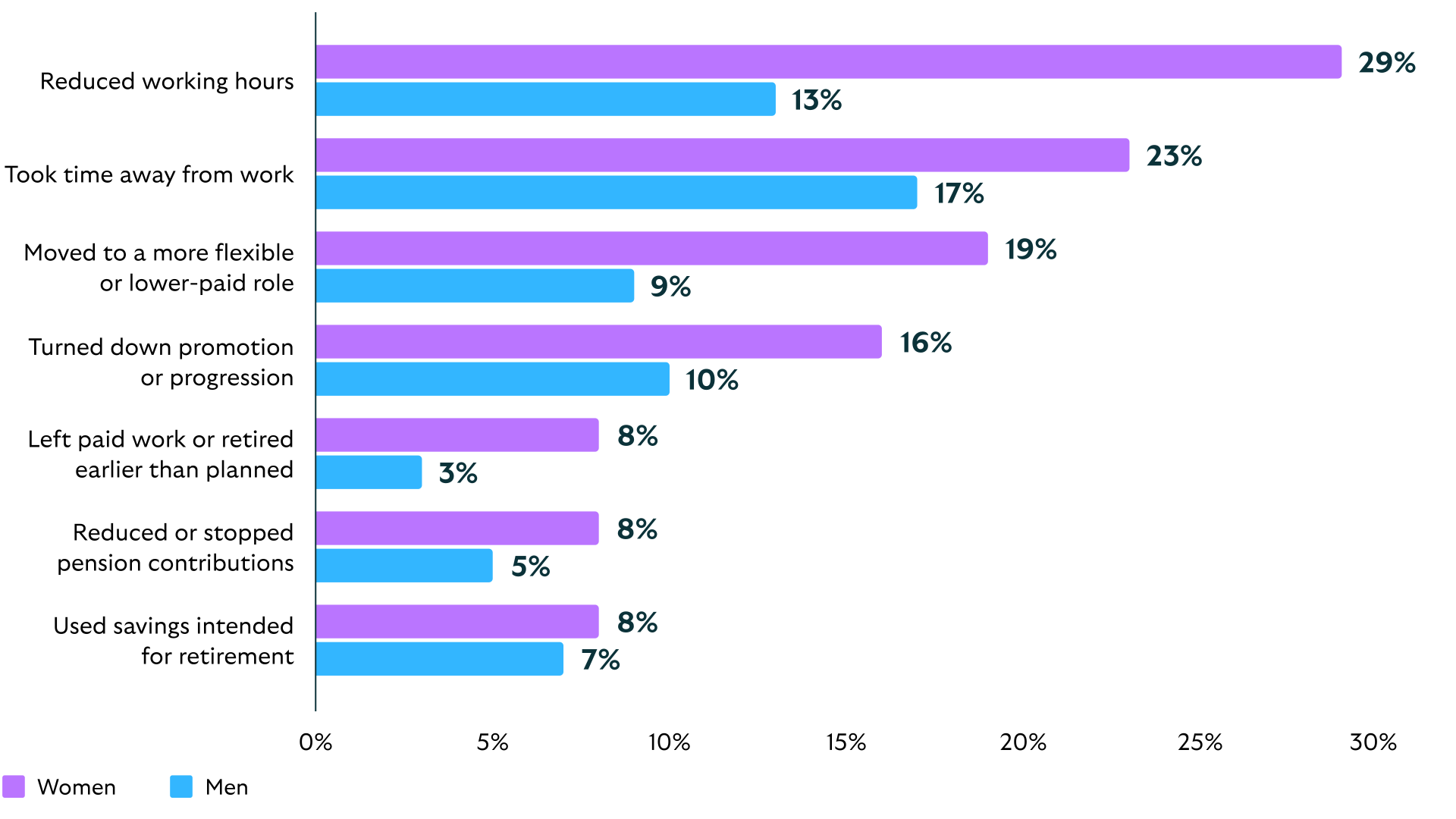
Note: Multiple responses possible, so categories overlap. ‘None of the above’ and ‘Prefer not to say’ are not displayed.
The pension cost of adult care
Reducing paid work to care for an adult can have a significant effect on both earnings and pension saving.
A woman earning the median full-time salary of around £35,700 would have around £2,350 a year paid into her pension at minimum automatic-enrolment rates. Working one day less each week for a year would reduce her earnings by around £7,100 and pension contributions by around £570, cutting annual pension saving by almost a quarter. A three-month unpaid break would mean around £8,900 less pay and £590 less going into her pension, while a full year away from work would mean around £35,700 in lost earnings and £2,350 in missed pension contributions.
Across the UK, our survey suggests around 380,000 women aged 18-64 currently work part-time to give themselves greater flexibility to care for another adult. If each carer worked one day less a week than she otherwise would, the combined effect would be around £220 million a year in missed pension contributions, before allowing for the investment growth those contributions could have generated.
Periods away from work can add substantially to this cost over a lifetime. Around 2.5 million women aged 18-64 have taken time away from work at some point because suitable or affordable adult care was hard to access. Most reported relatively short absences, with 58% taking three months or less in total, but around 4% reported spending more than 10 years away from work. If these periods of leave were unpaid, they would equate to around £5.9 billion in missed pension contributions at today’s pay and contribution rates.

Expert analysis
Debbie Sheffield
Relationship Director, Scottish Widows
One of the challenges with unpaid caring is that the pension impact can be surprisingly hard to see until it is too late.
Employers may look at pension participation, contribution rates or engagement data to understand how their people are doing. But carers may not stand out. They may still be working and contributing, but may have reduced their hours, taken unpaid leave, stepped into a lower-paid role or missed opportunities for progression.
In other words, they can slip through the net. Their pension is still there, but its trajectory has changed, and the true impact may only become apparent much later, when there is far less time to put things right.
That is why we need to look beyond pension data alone and recognise the moments when someone’s working life changes as opportunities to offer support. Employers and pension providers can help by making the impact visible, signposting support such as National Insurance credits, and helping people stay connected to pension saving wherever possible.
And even these figures are unlikely to tell the whole story. They cannot fully capture lost salary progression, missed promotions, lower future contributions or investment growth. The real retirement cost of unpaid care can extend far beyond the period in which care itself is provided.
So what can we do differently?
For employers, pension providers and policymakers, there are some practical opportunities:
- Identify the moments that matter. A reduction in hours, carers’ leave, extended absence or return to work should be a prompt for relevant pension information and support.
- Look beyond contribution rates. Someone contributing at the default rate may appear financially engaged while actually saving significantly less because their salary and working hours have fallen.
- Make support easier to find. Awareness of National Insurance credits and Carer’s Credit is low among the women in this research. Better signposting can help people protect at least part of their future State Pension entitlement.
- Help people understand the long-term impact. Show what reducing hours or taking time away could mean for retirement saving, while recognising that for many carers these are not straightforward choices.
- Make returning to work a pension moment too. Returning to work or increasing hours creates an opportunity to review contributions and, where affordable, begin rebuilding retirement saving.
- Design for carers, rather than expecting carers to find us. Communications and workplace support need to recognise that someone balancing work and substantial caring responsibilities is unlikely to have the time or headspace to seek out complicated pension information.
- It’s worth looking at our Invest In You hub, which brings together guidance, tools and products to support people in building their financial future.


