


India’s quality, at a discount


Avinash Vazirani and Colin Croft set out why their approach to finding reasonably priced stocks has important lessons for active investors disheartened by recent setbacks.
The last two years have been hard work for investors holding Indian equities while the EM index has been carried upward by a handful of North Asian AI plays. MSCI India has now underperformed MSCI EM by some 35% year-to-date1, a divergence rarely seen in either direction, against a five-year average closer to +21%. Foreign flows have followed the narrative, with capital rotating out of India and into the Korean and Taiwanese semiconductor complex.
For long-term investors, this is usually where the work begins. When relative performance moves this far on a single thematic story, two questions matter:
- Has the thing being sold actually got worse?
- Has the thing being bought actually got better, on more than one variable?
On both counts, the case for following the crowd looks thin.
India is the quality EM that avoids AI over-concentration risk
The EM rally has been narrow, with capital chasing a small number of memory and foundry names in South Korea and Taiwan as expected beneficiaries of the AI boom. India’s broad based NSE 500, by contrast, is driven by a diverse set of companies across financials, consumer, healthcare, energy, industrials and aviation.
It’s important to note that the NSE 500’s concentration risk is far lower than MSCI EM. The effective number of stocks (ENS), a measure of how many names actually drive an index’s returns, for the NSE 500 sits at roughly 15% of constituents, or around 75 names, compared with just 6% for MSCI EM2.
It is also being built on better foundations. Indian corporates deliver a median 5-year ROE of c.15%, materially higher than the 8-12% range across other large Asian EMs, and closer to what European DM indices generate. Median 3-year profit margins of 12% match the S&P 500 and sit well above the 9% EM average. On leverage, India screens at the bottom of the EM table with debt-to-assets of just 13%, lower than most developed-market indices. On a two-year forward view, NSE 500 sales growth is forecast at 14%, roughly double the EM aggregate of 8%. Only Taiwan within EM and the Nasdaq within DM come close, both at around 12%3.
In short, India has the growth, the profitability, the margins, and the balance-sheet quality. The rest of EM, outside the AI complex, increasingly does not.
MSCI India has now underperformed MSCI EM by some 35% year-to-date
Domestic anchor
A second reason to question the herd is that the marginal buyer of India has changed.
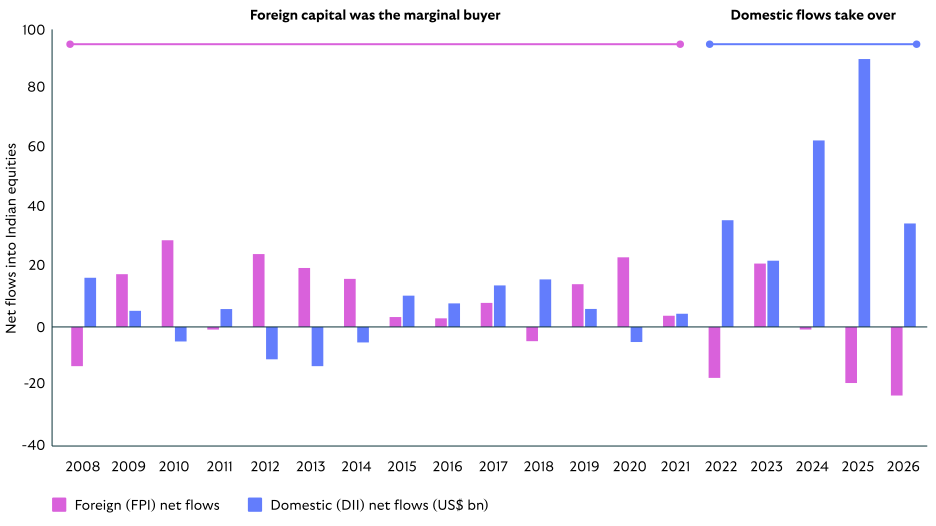
Over the past three calendar years to end-April 2026, foreign portfolio investors (FPIs) have pulled approximately $43bn out of Indian equities. Over the same period, domestic institutional investors, including Indian mutual funds, insurance companies, pension funds, banks and AIFs, have invested $188bn. The asymmetry is not subtle.
Domestic investors have replaced foreigners as the buyer of Indian equities
Source: Jefferies, as at end April 2026
The structural break is visible in the chart. Through most of 2008–2017, foreign capital was the marginal buyer of Indian equities, while domestic flows averaged just ~$3bn per year. From 2018 the picture inverts, and from 2022 decisively so. CY2025 saw a record $90bn of net domestic buying. March 2026 was the single largest month of foreign selling in the dataset, at $14.2bn, and was more than matched by domestic purchases of $15.4bn. Even in the worst month for foreign capital on record, institutional flows still netted positive.
This matters in two ways.
On equity-market behaviour, the reflex assumption that FPI selling produces a disorderly Indian market is a decade out of date. India now has an ownership structure in which domestic institutions hold a record share of Nifty 500 companies, at around 20%, ahead of FPIs at roughly 17%4. SIP-driven monthly contributions arrive with calendar-like regularity. The historical relationship between FPI flows and Nifty direction has broken because the underlying supply/demand balance has changed.
On the rupee, the slide from 85 to 95 rupees per dollar since early 2025 is not an India-fundamentals signal. It is a consequence of the same FPI rotation. Domestic investors buying $188bn of Indian equities did not need to sell USD to do so because they were already funded in INR. Foreign investors selling $43bn of Indian equities did need to buy USD to repatriate. The FX market sees the gross foreign outflow, not the domestic offset. The rupee weakness is an FX-market reflection of the same FPI underweight that has driven equity underperformance, not an independent risk.
India is being abandoned by foreign capital at the same time as its domestic capital base is investing at record rates, on improving fundamentals, into the most diversified opportunity set in EM. That is the textbook description of a contrarian set-up.
The valuation pushback, and the response
The honest counter is that none of this is free. The MSCI India index trades at around 22x trailing earnings against MSCI EM at ~17x, a 30% plus premium that has kept generalist EM allocators away. Look beneath the index and the picture is more striking still. The median NSE 500 stock trades at 35x, reflecting just how richly the small and mid cap end of the market is priced.
Cheaper than the benchmark, with better growth
The Jupiter India Select portfolio has been built on a single discipline: own the structural growth story of India, the world’s fastest growing major economy, but not at any price.
As at 30th April 2026, the fund’s weighted valuation metrics sit below those of the MSCI India benchmark on every multiple we measure, while delivering higher historical earnings growth:
- Trailing P/E – lower than the benchmark.
- Price/book – lower than the benchmark.
- Price/cash flow – lower than the benchmark.
- Historical 3-year EPS growth – higher than the benchmark.
Jupiter India follows a Growth at a Reasonable Price (GARP) approach to investing
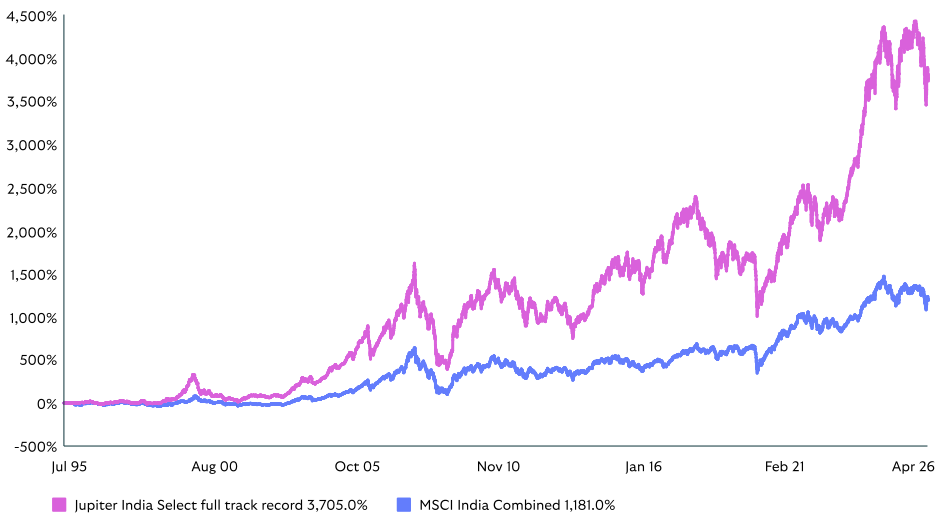
Past performance does not predict future returns. Fund performance data is calculated on a NAV to NAV or bid to NAV basis, dependent on the period of reporting. All performance is net of fees with income reinvested. Historical data. Cumulative performance. Source: Morningstar, in USD, from 14.07.1995 to 30.04.26. Jupiter India Select L USD A Inc share class was used for the performance of the Peninsular South Asia Investment Company Limited from 14.07.1995 to 02.05.2008. Jupiter India Select D USD Acc share class from 02.05.2008 to present. Spliced benchmark: MSCI India GR from 14.07.1995 to 02.05.2008 and MSCI India NR from 02.05.2008 to present.
This is the GARP claim made operational. We are not paying the index multiple, let alone the 35x of the median stock.
India is being abandoned by foreign capital at the same time as its domestic capital base is investing at record rates, on improving fundamentals, into the most diversified opportunity set in EM.
Three pockets the benchmark misses
Three structural features of the Indian market, features that generalist EM funds typically struggle to exploit, make this possible.
- The off-index sweet spot. The MSCI India benchmark is heavily skewed to mega-caps. But there are a number of listed Indian companies in the $1bn-$5bn band, largely uncovered by sell-side research and under owned by foreign investors. Generalist EM funds cannot give this universe the time it requires, we can. They are typically growing businesses on materially lower multiples than their large-cap peers, often well before any index-inclusion catalyst.
- Undervalued and under-researched enterprises. India is home to many large businesses spanning sectors that offer opportunities for active investors. Painstaking research and patience are key to spot and benefit from those opportunities.
- Structural compounders. In sectors where Indian penetration sits at a fraction of EM levels, and further still below DM, there are listed champions with a multi decade runway. Private healthcare, domestic aviation, and branded consumer goods tend to compound earnings at mid teens to high twenties CAGRs over multi year windows. The price paid still matters. We will not own them at any multiple, but where we do, the compounding does the work.
The portfolio that results is mostly large and liquid, with a weighted average market cap of c.$31bn as of 30.04.26, while the differentiation comes from a deliberate tilt into the inefficient corners that both the index and most foreign capital ignore.
The bottom line
India offers the strongest growth profile in EM, the most resilient balance sheets, profitability comparable to developed markets, a meaningfully more diversified opportunity set than the EM benchmark itself, and a domestic capital base that has decisively replaced foreign flows as the marginal buyer. The headline index is not cheap, but the index is not the trade. Through the Jupiter India Select strategy, GARP-minded investors can access India’s quality and growth at a valuation discount to the benchmark, with the active alpha sitting in the off-index sweet spot, the undervalued re-rating, and a selective list of structural compounders.
In our view, the relative-performance gap with EM will not stay this wide forever. The four conditions that would close it, foreign selling exhaustion, rupee stabilisation, oil moderation, and EM earnings revisions broadening, are largely external to India. When they line up, the necessary work will already have been done in portfolios built while the rest of the market was looking elsewhere.
| As of 30/04/26 | May 16 – Apr 17 |
May 17 – Apr 18 |
May 18 – Apr 19 |
May 19 – Apr 20 |
May 20 – Apr 21 |
| Jupiter India Select | 38.03% | -2.20% | -13.25% | -26.96% | 41.94% |
| MSCI India – Net Total Return Index | 20.11% | 12.60% | 3.11% | -20.15% | 50.44% |
| As of 30/04/26 | May 21 – Apr 22 |
May 22 – Apr 23 |
May 23 – Apr 24 |
May 24 – Apr 25 |
May 25 – Apr 26 |
| Jupiter India Select | 20.77% | 1.20% | 60.41% | 7.84% | -8.26% |
| MSCI India – Net Total Return Index | 16.98% | -6.95% | 34.40% | 4.24% | -9.84% |
Past performance is no indication of current or future performance. Performance data does not take into account commissions and costs incurred on the issue and redemption of shares. Source: Morningstar, Jupiter Asset Management Limited. Share price stated close to close and includes any reinvestment income. NAV per Ordinary Share is the cumulative income NAV with debt at fair value and includes any reinvested income.*D USD Acc share class.
1 Calculations based on Bloomberg data as of May 28, 2026
2 Bloomberg Intelligence, May 2026
3 Bloomberg Intelligence, May 2026
4 Motilal Oswal, Nifty-500 institutional ownership data, Q1 CY2026, reported via Business Standard, 6 May 2026
5 MSCI India and MSCI EM trailing P/E, MSCI factsheets, end-March 2026.
Fund risks
- Currency (FX) Risk – The Fund can be exposed to different currencies and movements in foreign exchange rates can cause the value of investments to fall as well as rise.
- Pricing risk – Price movements in financial assets mean the value of assets can fall as well as rise, with this risk typically amplified in more volatile market conditions.
- Market Concentration Risk (Geographical Region/Country) – Investing in a particular country or geographic region can cause the value of this investment to rise or fall more relative to investments whose focus is spread more globally in nature.
- Derivative risk – the Fund may use derivatives to reduce costs and/or the overall risk of the Fund (this is also known as Efficient Portfolio Management or “EPM”). Derivatives involve a level of risk, however, for EPM they should not increase the overall riskiness of the Fund.
- Emerging Markets Risk – Emerging markets are potentially associated with higher levels of political risk and lower levels of legal protection relative to developed markets. These attributes may negatively impact asset prices.
- Liquidity Risk – Some investments may be hard to value or sell at a desired time and price. In extreme circumstances this may affect the Fund’s ability to meet redemption requests upon demand.
- Liquidity Risk (general) – During difficult market conditions there may not be enough investors to buy and sell certain investments. This may have an impact on the value of the Fund.
- Counterparty Default Risk – The risk of losses due to the default of a counterparty on a derivatives contract or a custodian that is safeguarding the Fund’s assets.
For a more detailed explanation of risk factors, please refer to the “Risk Factors” section of the Prospectus.


