


AI and technology adoption

To say the rise and impact of AI has been supersonic would be a serious understatement. It’s the talk of the town; and regardless of individual opinion, it simply can’t be ignored. In some way, shape or form, the majority of us have interacted with AI, and many are now adopting it as part of our working practices, including paraplanners.
However, with this comes considerations on how firms formally adopt and manage it – whether that’s establishing policies or introducing frameworks to govern the use of AI. This begs the question – how are paraplanners adopting it; and what benefits are they seeing?
How is AI being harnessed by paraplanners?
When it comes to how paraplanners are incorporating AI in their roles, taking meeting notes and conducting appropriate documentation is by far the most common use by 85% of paraplanners currently using AI – suggesting its primary role is centred on administrative support and streamlining communication. More than a third (35%) are using it for suitability report writing, whereas just over a quarter (26%) are harnessing AI to conduct fact-finding and data gathering.
In terms of where paraplanners currently using AI are turning to for support, compliance and technical teams are the first port of call for half (48%) of those seeking help. This is followed by peer networks (22%) as the second-most common source of support. Somewhat surprisingly, given the plethora of online information and assistance, only 9% of paraplanners turn to online resources for any guidance or assistance on AI use.
With support more readily available and more paraplanners turning to AI, many anticipate that utilisation comes with benefits. Greater time efficiency owing to the reduction of manual administrative tasks is by far the most anticipated of AI use, according to 82% of paraplanners; aligning with the common perception that AI offers the ability to automate time consuming, repetitive tasks. Two thirds (66%) also expect AI to enable faster suitability report generation.
Expected benefits
The current landscape – how are firms currently using and managing AI?
Despite some positive signs of AI use among paraplanners – whether to optimise admin, or take notes – surprisingly, few actually have official guidance in place. Just 12% of paraplanners said their company has a fully formalised AI policy or established framework policy; although 35% are in the process of developing one. On the flipside, 43% don’t have any guidance in place at all.
Of those who do not currently have frameworks, nearly half (48%) are still exploring how AI will be used before they introduce official policy, and over a third (36%) stated that it’s not a business priority. One in five (21%) said there is not enough business demand for AI to require frameworks being brought in.
Only 12% of paraplanners said their company has a fully formalised AI policy or established framework policy…
The trade-off – what are the concerns acting as barriers to AI utilisation?
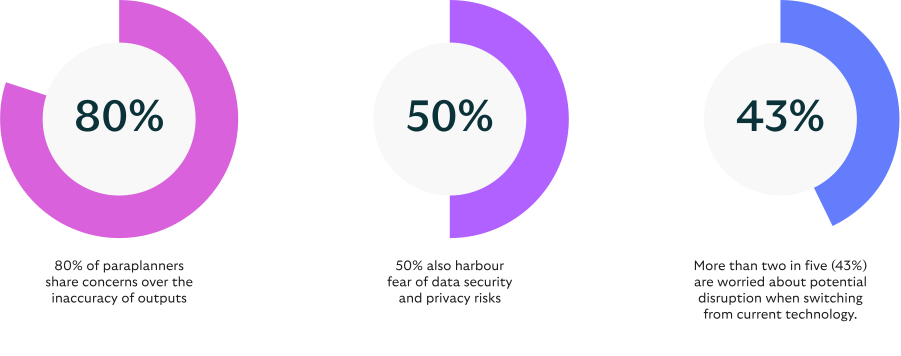
While benefits are anticipated, barriers still stand between paraplanners and the widespread, rapid adoption of AI. 70% of paraplanners share concerns over the inaccuracy of outputs, and half (50%) also harbour fears of data security and privacy risks. More than two in five (43%) are also worried about potential disruption when switching from current technology.
Barriers halting AI adoption
The cost element also cannot be overlooked. The financial outlay on new technology remains the biggest barrier in the eyes of 61% of paraplanners, indicating a financial concern among the majority of araplanners. Nearly one in five (18%) of paraplanners also believe AI adoption is outside of their remit, agreeing that they don’t have the buying power to influence the buying decisions needed to introduce new technology.
What does this ultimately mean for businesses?
AI is a constantly evolving consideration, moving higher up the agenda of many businesses and paraplanners. Its use is increasing and there’s obvious benefits, but with that comes risks, cost factors and concerns on the impact of the human factor – as well as security considerations
Establishing policies and frameworks goes some way to introducing AI in a more secure, pragmatic and beneficial way, though this needs to be done sooner rather than later to enable harmonious use across a business. Paraplanners, understandably, retain reservations over compliance issues and sign-off surrounding AI, as well as potential impacts on the human element of their role. Striking a balance will hold the key to harnessing the power of AI – the benefits are clear, but it requires a carefully managed, integrated and efficient introduction.


