The changing global energy mix: implications for economies, opportunities for investors

The global energy mix is shifting. In this article, Eva Cairns, Head of Responsible Investment, review what that transformation looks like and what it can mean for investors, economies and policy.
For decades fossil fuels have powered economic growth and dominated the energy sector. But with growing recognition of the environmental costs associated with them, the uptake of renewables has increased considerably. In the 10 years before the Paris Agreement, 68% of the world’s electricity demand growth was met by fossil fuels1. Since 2015, however, although global demand for electricity has grown faster than ever, renewables have met two-thirds of this increase.
Three year global electricity demand growth met by fossil fuels vs low carbon sources
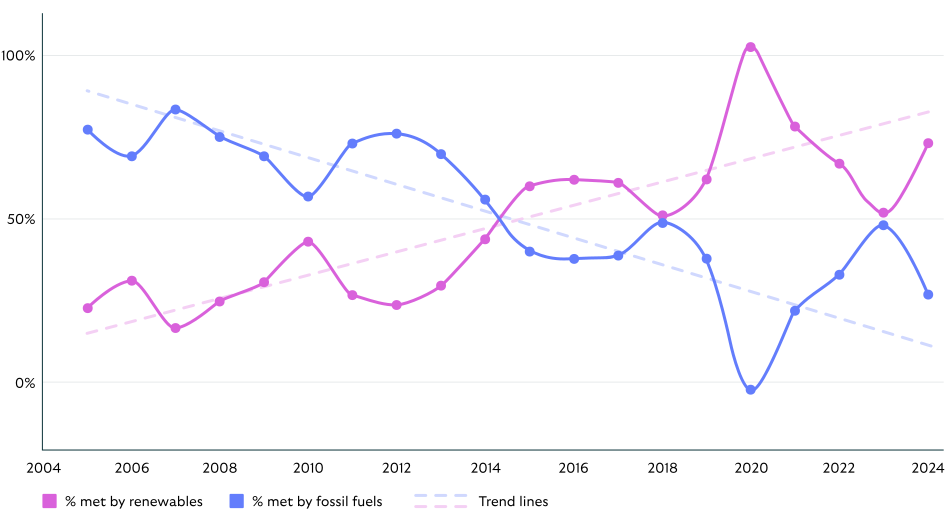
Source: Our world in data (2025a), Global Carbon Budget (2024) ECIU analysis
The growth in adoption of renewables has been supported by technological advances that have helped to drive costs down, as well as supportive policies, including subsidies and carbon pricing.
The growth in adoption of renewables has been supported by technological advances that have helped to drive costs down, as well as supportive policies, including subsidies and carbon pricing.
Drivers of renewables growth
Figures from the European Environment Agency show that 25.4% of all energy used in the EU in 2024 came from renewable sources.2 Its target is a minimum of 42.5% by 2030. Meanwhile, globally, renewables saw a record annual capacity growth of 15.1% in 2024.3
Renewable share of annual power capacity expansion (2014-2024)
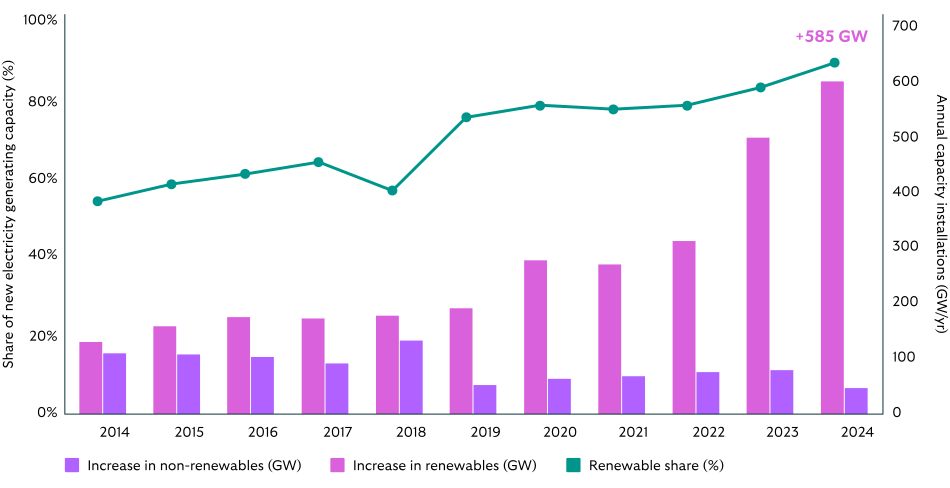
Source: IRENA, International Renewable Energy Agency
While the pace of change is promising, it varies by region. Most of the increase in the global growth rate comes from Asia, with China contributing almost 64% of the added global renewables capacity, as we can see in the case of solar technologies in the chart below.
Solar PV global capacity additions, Shares of top 10 countries and rest of world, 2024
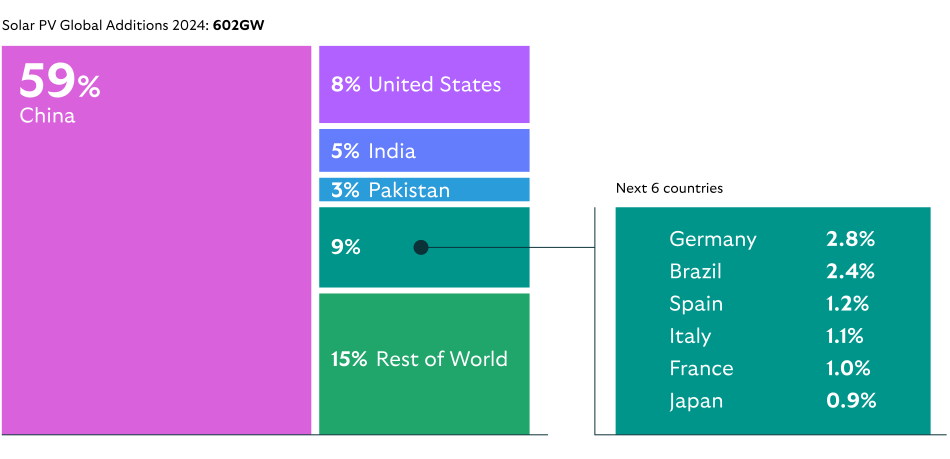
The G7 countries (Canada, France, Germany, Italy, Japan, the UK and the US) accounted for 14.3%.
So, what’s behind this surge in emerging market investment in renewables? Well, there are a number of factors, including:
- Growing demand for energy: Population growth and economic expansion increase the need for reliable energy sources, that’s where renewables can play an important role and can be deployed flexibly across regions where low cost solar and wind are readily available.
- Trade volatility and shifting geopolitics: Many emerging markets import fossil fuels, which can increase their exposure to price volatility and make them vulnerable to supply disruption or geopolitical pressure.
- Economic opportunity: The renewable energy sector can offer new employment opportunities and the development of domestic industry, providing a boost to economic growth.
- Environmental concerns: Developing nations can be disproportionately affected by air pollution and the effects of climate change. Transitioning to renewables can help reduce these risks and improve public health.
Country example: India’s experience of renewables investment
In India, a growing population, fast-developing economy and significant public health problems caused by an over-reliance on fossil fuels, drove a series of policy decisions to promote and invest in renewables. In 2010, the Indian government unveiled its flagship initiative, the National Solar Mission, to promote the deployment of solar energy across the country. Initiatives such as the Production-linked Incentive Scheme for Solar PV, saw significant investment to promote the domestic manufacture of solar PV panels and reduce dependence on imports. To date, it has created around 44,000 jobs.4 Additional schemes include providing solar panels to households and promoting their use in agriculture.
In December 2025, the Indian government reported that non-fossil fuel power had crossed a threshold, accounting for more than 50% of India’s energy capacity. Around 2.4 million households have rooftop solar panels, and there has been a significant boost in clean energy used in agriculture. This success translates to growing energy independence and security, as well as lower costs and greater sustainability – ticking all the boxes of what’s commonly referred to as the ‘energy trilemma’.
Investment challenges and overcoming them
India’s success, however, should not distract from the challenges that emerging markets face in developing renewable energy. Principal amongst these is unlocking the investment needed to fund large-scale infrastructure costs and servicing any associated debt, as well as the upgrading of grid systems to integrate new technology. Potential regulatory or policy barriers can also impede investment, as can political and economic stability.
Moves by the international community to support developing economies to overcome these challenges can be key to investor confidence. This includes policy incentives and mechanisms such as the annual climate conference (COP30, most recently held in Brazil). They recognise the pivotal role these economies can play in achieving global emissions reductions. With some having the potential and ambition to bypass traditional energy infrastructure and move directly to renewables, this will be crucial to the ambition of achieving net zero.
Recognising and leveraging the opportunities that a transition to low carbon energy sources can bring will be key to helping capture long-term value.
Understanding opportunities and risks
According to the International Energy Agency (IEA), the world invests almost twice as much in clean energy (this includes both renewables and other clean energy sources, such as nuclear) as in fossil fuels, with US$2.2 trillion invested in clean energy technologies and infrastructure according to its 2025 report.5 Much of this investment is driven by the private sector, with the IEA stating that, in order to keep the 1.5°C emissions target within reach, the “annual investment required in renewable power still needs to double to achieve a tripling of installed renewable capacity by 2030, accompanied by rising spending on grids, storage and other forms of flexibility to ensure secure and cost-effective utilisation of this capacity”.
While the IEA also recognises that an overshoot of the 1.5°C target is now “inevitable”, it states that the uptake of low emissions technologies would support some reduction in emissions, taking both the renewables capacity target and the most recent nationally determined contribution statements into account, see trajectory below.
Energy related CO2 emissions by scenario, 2010-2050

Source: World Energy Outlook 2025, IEA.
The global energy mix is changing rapidly, but more is clearly needed. This transition presents both risks and opportunities. Emerging markets can offer attractive returns for those seeking renewable investment opportunities, but they are not without risk. Developed economies too have an opportunity to drive sustainable growth through low carbon energy sources and contribute to achieving their net zero targets.
Investors must navigate an evolving policy landscape, concerns around energy affordability and disruptive technologies. Recognising and leveraging the opportunities that a transition to low carbon energy sources can bring will be key to helping capture long-term value.
1 ’10 Years Post-Paris’, Energy & Climate Intelligence Unit, October 2025. 10-Years-Post-Paris_Report_2025.pdf
2 ‘Share of energy consumption from renewable sources in Europe’, European Environment Agency, 6 November 2025. Share of energy consumption from renewable sources in Europe | Indicators | European Environment Agency (EEA)
3 ‘Record-Breaking Annual Growth in Renewable Power Capacity’, International Renewable Energy Agency, 26 March 2025. Record-Breaking Annual Growth in Renewable Power Capacity
4 ‘India’s Solar Momentum’, Press Information Bureau, Indian Government, 6 December 2025. Press Release:Press Information Bureau
5 ‘World Energy Investment 2025’, International Energy Agency, 5 June 2025. World Energy Investment 2025 – Analysis – IEA