


Sequencing risk and longevity risk: the two retirement risks every adviser should plan for

For many clients, retirement is no longer a brief period after work. It can be a multi-decade phase of life, with retirees potentially remaining invested for 20, 30 or even 40 years after they stop working. The challenge for advisers is not simply helping clients build wealth for retirement but helping them sustain it throughout retirement
Two of the biggest threats to retirement income sustainability are sequencing risk and longevity risk. While these risks are often discussed separately, they’re actually closely interconnected and need to be considered together when designing decumulation strategies.
Understanding sequencing risk
Sequencing risk refers to the danger of experiencing poor investment returns at the start of retirement, particularly when withdrawals are already being made from a portfolio.
For an investor in the accumulation phase, market volatility can often be advantageous because regular contributions allow them to buy assets at lower prices during market downturns. However, the situation changes significantly in retirement. When a client is drawing an income, negative returns early in retirement can permanently damage the portfolio’s ability to recover.
This happens if clients must sell assets to fund their spending needs, regardless of market conditions. During a downturn they can lock in losses and reduce the amount of capital available to participate in future market recoveries.
Why sequencing risk matters
Consider two clients with identical retirement savings, identical average investment returns and identical withdrawal rates. If one experiences strong returns in the early years of retirement and the other experiences market declines, their long-term outcomes can be dramatically different as can be seen in the illustrative example below.
Illustrative example: same average return, different outcome
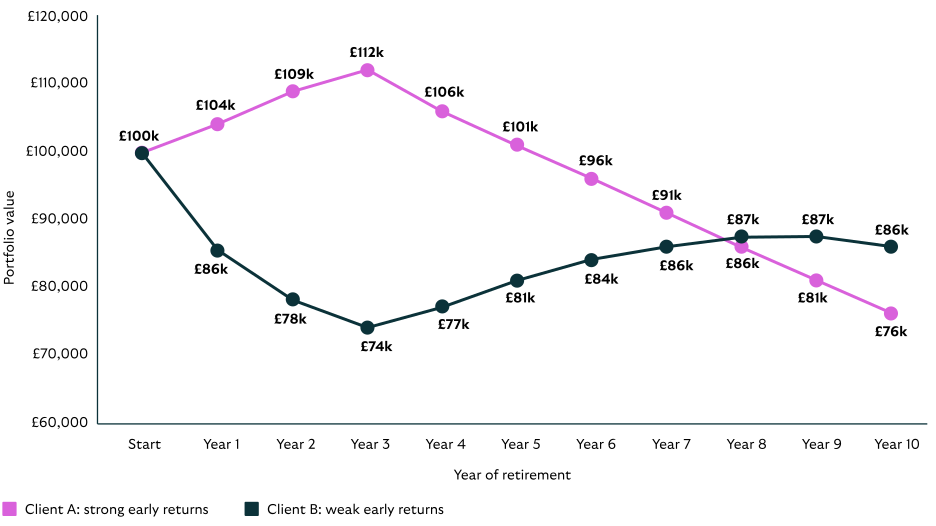
Early losses can have a lasting impact in retirement, because withdrawals reduce the capital available to benefit from any later market recovery.
The sequence of returns matters just as much as the average return achieved.
This challenge becomes more acute as retirees spend longer invested. As retirement horizons extend, advisers must strike a balance between protecting clients from market shocks and maintaining exposure to long-term growth opportunities. De-risking too aggressively may reduce volatility, but it can also undermine a portfolio’s ability to sustain withdrawals over the long term.
Understanding longevity risk
Longevity risk is the risk that a client outlives their retirement savings.
Advances in healthcare and living standards mean retirees are living longer than previous generations. According to the Office for National Statistics, around one in four people aged 65 could live into their nineties.
This creates a significant planning challenge. A client retiring at 65 may need their pension assets to generate income for 30 years or more.
Many retirement strategies have historically focused on capital preservation. However, when retirement lasts several decades, inflation and spending needs can erode purchasing power over time. Retirees therefore need portfolios that continue to deliver growth alongside income. Or in other words, retirement investing now needs to work ‘to and through’ retirement.
The challenge for advisers is not simply helping clients build wealth for retirement but helping them sustain it throughout retirement.”
The tension between sequencing and longevity risk
The reality is that sequencing risk and longevity risk often pull advisers in opposite directions. To reduce sequencing risk, advisers may be tempted to increase allocations to cash and defensive assets. To reduce longevity risk, however, clients typically need ongoing exposure to growth assets capable of delivering real returns over the long term.
This creates a central retirement planning dilemma: De-risk too aggressively and clients may struggle to maintain purchasing power and income sustainability. Remain too exposed to growth assets and poor early retirement market returns could cause lasting damage.
The solution is rarely found in a simple switch from growth assets into lower-risk investments at retirement. Instead, advisers increasingly need more dynamic and outcome-focused approaches to portfolio construction.
Moving beyond the traditional retirement glidepath
Historically, retirement planning often centred on a linear glidepath, gradually reducing equity exposure as retirement approached.
While this approach can help manage volatility, today’s retirees face a more complex reality. People are accessing pensions in different ways, retiring flexibly and remaining invested for much longer. Retirement outcomes therefore need to be designed around actual member behaviour and income requirements.
The objective should be to balance three competing priorities:
- Sustainable income.
- Capital preservation.
- Continued participation in long-term growth opportunities.
This balance sits at the heart of effective decumulation design.
Using portfolio segmentation to manage risk
One increasingly popular framework is portfolio segmentation, often referred to as a ‘bucketing’ approach.
Rather than viewing retirement assets as a single pool, the portfolio can be divided into segments aligned to different time horizons. This may include:
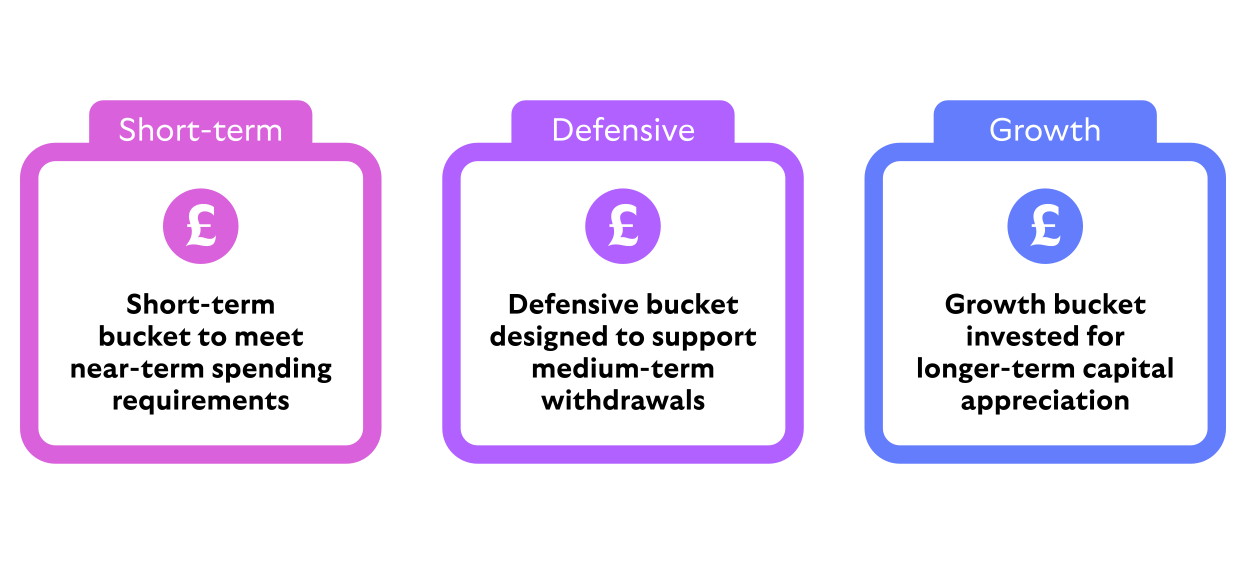
This structure can help reduce sequencing risk because short-term withdrawals can be funded from cash or defensive assets during periods of market stress, avoiding the need to sell growth assets at depressed prices.
At the same time, maintaining a dedicated growth allocation helps address longevity risk by allowing part of the portfolio to continue compounding over the long term.
Looking beyond traditional asset classes
Another implication of longer retirement journeys is the need to consider a broader range of income-generating assets.
Traditional retirement portfolios have often relied heavily on a combination of equities and bonds. However, alternative asset classes and private markets may offer additional sources of diversification, inflation-linked cashflows and different return drivers, which could help dampen volatility.
The key consideration is not simply whether an asset class belongs in the accumulation phase, but whether it can contribute to delivering sustainable retirement outcomes.
Building retirement solutions for a longer future
As retirement evolves, advisers may need to rethink how they assess investment risk.
Rather than focusing solely on short-term volatility, successful retirement portfolios should seek to support sustainable income, manage sequencing risk and maintain sufficient growth potential to combat longevity risk.
A more adaptive framework means aligning investments to client outcomes at different stages of retirement, explicitly designing for decumulation and recognising that clients may remain investors for decades after they stop working.
Takeaways
- Sequencing risk can permanently impair retirement outcomes if poor market returns occur early in retirement while withdrawals are being taken.
- Longevity risk is increasing as retirees live longer and require income for potentially 30 years or more.
- Managing one risk cannot come at the expense of the other. Successful retirement strategies must balance capital preservation with continued growth.
- Outcome-focused approaches, including portfolio segmentation and broader sources of income and diversification, can help advisers build more resilient decumulation solutions.
- Ultimately, retirement planning is no longer just about reaching retirement. It is about helping clients remain invested with confidence throughout the journey that follows.


