How AI is changing search, and what it means for Google, ChatGPT and the open web

The use of generative AI in search is on the rise and has profound implications for search engines like Google, as well as for companies who rely on clicks to make sales.
Google became the gateway to the internet because it got users the information they wanted as quickly as possible. Initially, the best way to do this was sending the user to an external website, minimising time on google.com. Google’s original model centres around “10 blue links” to external sites, but developed to improve query responses, offering Maps, Images, YouTube, Shopping, as well as “featured snippets”.
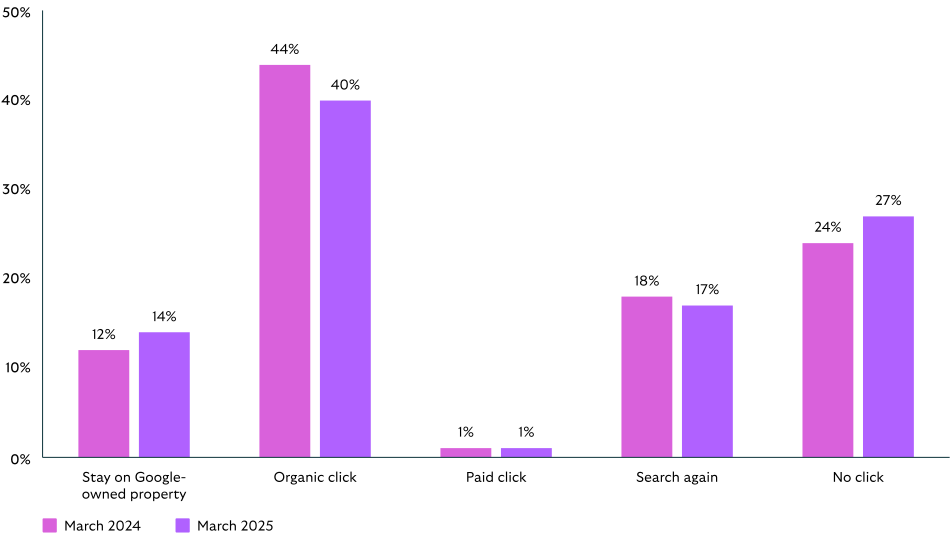
The latest additions to Google’s armoury are AI Overviews and AI Mode. Google’s model has moved far from its 10 blue link origins. Now, 27% of searches result in no clicks whatsoever. This means fewer people are being sent outside of google.com. Just 56% of searches result in a click, which often includes Google’s own tabs such as Images, YouTube or Shopping.
How traditional search supports the open web
By connecting browsers with external sites, Google supports the open web. Website owners can sell something (a product, service, subscription) or show advertising. Traffic can arrive organically to websites, or via paid search.
For paid search, the site will bid an amount to show up at the top of the results page for a certain query. Paid searches skew heavily to commercial queries, because these are more likely to generate a return on the spend through selling a product.
For organic search, a company will create and maintain the content on its website to maximise exposure to Google’s algorithm. If the content is deemed relevant to a particular query, then the link will be shown, and the site will not have to pay Google for the click.
How ChatGPT is closing the open web
ChatGPT is challenging this model. Users are spending more time engaging directly with ChatGPT with less exposure to external links.
Google’s response to ChatGPT – AI Mode and AI Overviews – shows how AI responses have accelerated this trend. The below chart shows how in the period March 2024 to March 2025, where AI answers have become increasingly prevalent in Google’s results, the percentage of searches that result in “no clicks” has increased at the detriment of “organic clicks” to external sites. Google is keeping users within Google more.
Changing Google search habits in 12 months, US desktop searches
Source: Semrush
The result is that the open web is becoming closed. An increasing proportion of activity sits within the gateways to the internet, whether that is Google or ChatGPT.
This is impacting business models. News sites, for example, require time spent on page to monetise content via advertising, as opposed to selling goods. If gateways provide news summaries, there is less need to visit news sites. We can see this in the data – organic traffic has declined to news sites as the percentage of searches that have no click-through increases.
This has led to multiple news outlets suing ChatGPT and Google to protect their existing monetisation model. However, it may prove too late for these business models as consumer has already made its choice on how it now wants information to be presented.
Less click-through, but more searches for ChatGPT and Google
ChatGPT, by its conversational nature, encourages queries that would never be “Googled”. ChatGPT users still seek information, as one would on Google, but also query in new categories such as image or video creation, technical help or writing skills, few of which consumers would have Googled pre-ChatGPT.
This change in behaviour is flowing through to Google too, with Google commenting in September 2024 that searches with more than five words are growing at 1.5x the rate of shorter queries.
How the monetisation opportunity may develop – “agentic commerce”
Currently, AI responses do not typically offer satisfactory answers to commercial queries. Users would be unlikely to ask ChatGPT for clothing options over Google for example, as the presentation of products, prices and reviews is lacking compared to “ordinary” search. Unlike informational queries, you can’t complete the transaction without leaving the gateway. This situation is developing though and it seems clear that commercial transactions within the gateway is a goal for both Google and ChatGPT. ChatGPT is now collaborating with Shopify and Walmart to enable users to purchase from merchants directly on the gateway.
This is a step towards “Agentic Commerce”, where an AI agent can fulfil some or all of a transaction on behalf of users. For example, could ChatGPT or Google send you a shortlist of family activities over certain dates, providing one-click payment links to significantly speed up the process of research and booking? In this scenario, you never leave the gateway. The difficulty of integrating across the open web cannot be understated, but both companies seem intent on improving the user experience in this way.
If this works, the revenue potential is in the hundreds of billions of dollars. If agentic commerce improves the shopping experience, then users are more likely to follow through on a purchase that otherwise might have not been made. Agentic commerce could also reduce the power of external websites compared to a gateway – fewer shoppers would go direct to source, and less of the transaction would be fulfilled by those sites. In theory, over time, more of the value of an online transaction shifts to Google or ChatGPT, in a similar manner to news or content.
How ChatGPT or Google monetise enabling transactions at the gateway is unclear. The existing paid search model would suggest external sites bid for placement, paying if clicked on, but a new model may emerge where there is no bidding for placement but the site pays the gateway if a transaction is completed.
Who will emerge as the winner?
Which of the gateways comes out on top is unclear as of today. For many people ChatGPT is AI and therefore it will capture a lot of this activity, Google however has superior reach and is already plugged into many businesses wanting to sell products and services.
In our view the opportunity is so significant that both can benefit
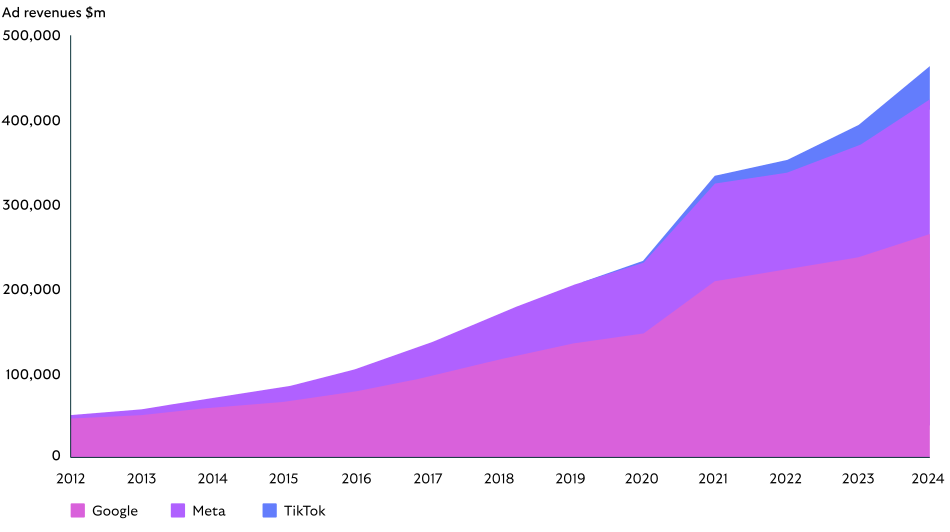
We have seen this previously in new markets – Google and Meta Platforms were often seen as competing against one another for budgets. Both significantly expanded the digital advertising market and took share from traditional advertising budgets, creating sizeable growth in earnings and shareholder value. Similarly, TikTok has outgrown Meta in recent years, but the addition of short-form video on Meta has ended up being a material tailwind for the business, as it continued to be a draw of budgets into the digital ad market.
All have shown significant growth
Source: Semrush
Both Meta and Google’s parent company Alphabet are part of the “Magnificent Seven” group of companies whose performance has dominated markets in recent years. Any threats to their market leading positions understandably cause concern. However, in these instances, disruption from challengers such as ChatGPT, or TikTok, can result in the overall market opportunity growing, even if Google or Meta’s absolute market share falls.
Careful analysis is needed to distinguish between disruption that may prove damaging, and disruption that creates new opportunities. Every case is different. Actively managed global approaches are needed to capture the nuance and the opportunity, wherever these may emerge.
For third-party sites there are some difficult choices to be made – do you pivot early and support ChatGPT/Google gaining more power? Or do you hold out to slow the speed of adoption, but potentially lose out when other competitors follow the consumer?
Marketing material for professional clients only. The views and opinions contained herein are those of the authors and may not necessarily represent views expressed or reflected in other Schroders communications, strategies or funds. This material is intended to be for information purposes only and is not intended as promotional material in any respect. This information is not an offer, solicitation or recommendation to buy or sell any financial instrument or to adopt any investment strategy. Nothing in this material should be construed as advice or a recommendation to buy or sell. Information herein is believed to be reliable but we do not warrant its completeness or accuracy. The material is not intended to provide, and should not be relied on for accounting, legal or tax advice. Reliance should not be placed on any views or information in the material when taking individual investment and/or strategic decisions. No responsibility can be accepted for error of fact or opinion. Any reference to sectors/countries/stocks/securities are for illustrative purposes only and not a recommendation to buy or sell any financial instrument/securities or adopt any investment strategy. Schroder Investment Management Limited, 1 London Wall Place, London EC2Y 5AU. Registration No. 1893220 England. Authorised and regulated by the Financial Conduct Authority. November 2025.
1 Approximate retail price, standard pocket-sized Labubu figures typically range from US$20 to US$30, depending on design and market.
2 Joan Verdon, ‘Labubu Remains King Of The Collectibles, StockX Reports’, (forbes.com), August 2025.
3 Adam Hancock, ‘Human-sized Labubu doll sells for more than $150,000’, (bbc.co.uk), June 2025.
4 Bloomberg News, ‘Labubu’s Mega Markups Make Pop Mart a $43 Billion Export Giant’, (bloomberg.com), June 2025.
5 See Ezra Greenberg, Kelsey Robinson, Olivia White and Tamara Charm, ‘The ‘value now’ consumer: Making sense of US consumer sentiment and spending’, (mckinsey.com), January 2025.
6 Shuyang Wang, Yun Liu, Yingying Du and Xingyuan Wang, ‘Effect of the COVID-19 Pandemic on Consumers’ Impulse Buying: The Moderating Role of Moderate Thinking’, (pmc.ncbi.nlm.nih.gov), October 2021.
7 International Data Corporation, ‘Worldwide Smartphone Market Grows 1.0% in Q2 2025, Despite Global Uncertainty and Weak Demand in China, according to IDC’, (idc.com), September 2025.
8 Autovista24, ‘What are the global EV market’s most successful brands?’, (autovista24.autovistagroup.com), February 2025.
9 Peter Hoskins, ‘Bubble tea chain bigger than Starbucks sees shares jump on debut’, (bbc.co.uk), March 2025.
10 Scott Murdoch and Sophie Yu, ‘Chinese bubble tea chain Mixue aims to raise $443 million in Hong Kong IPO’, (reuters.com), February 2025.
11 The EV Report, ‘BYD ETM6: A Customizable, Eco-Friendly Solution for Urban Logistics’, (theevreport.com), September 2024.
12 Lovey Mangal, ‘Pop Mart’s viral collectibles to fuel overseas revenue surge’, (spglobal.com), July 2025.